by Joel V Webb | Oct 16, 2026 | Uncategorized
We are all subject to one kind of schedule or another. We all have something we are building our lives around, whether it is the secular national calendar where we immensely look forward to the 4th of July, Memorial Day, Thanksgiving and other holidays where most get time off, and see family. But this has not always been the way we have lived. In the past, the life of the Christian world was built around the story of the Gospel, likewise punctuated with celebrating the lives of Christians who demonstrated the love and character of Christ, and thus we now call them saints. I have written on the Christian calendar before, and there are many other better articles on this topic that I could ever write.
If you don’t know the general flow and movements of the calendar, go read one of those linked articles, and then come back.
Ok. So you know what the calendar is. Is. But why? What makes keeping and building our lives around the Christian calendar so important? Well, in order to tell you, let’s explore the story of St. Brendan the Navigator. From IrishHistory.com:
St. Brendan’s most famous contribution to Irish religious folklore is his legendary voyage across the Atlantic. According to “Navigatio Sancti Brendani Abbatis” (The Voyage of Saint Brendan the Abbot), Brendan was inspired by the story of St. Barinthus, who claimed to have discovered a land of abundance, which Brendan understood to be the “Promised Land of the Saints.”
Intrigued and driven by spiritual curiosity, Brendan decided to undertake a voyage to discover this Promised Land. He reportedly built a curragh, a type of Irish boat with a wooden frame covered in animal hides, and set sail with a group of fellow monks.
The tales of Brendan’s voyage, which reportedly lasted seven years, are filled with fantastical elements. His journey, as depicted in the Navigation, included encounters with enormous sea creatures, a floating crystal pillar, an island that turned out to be a sea monster, and a mysterious island inhabited by a hermit.
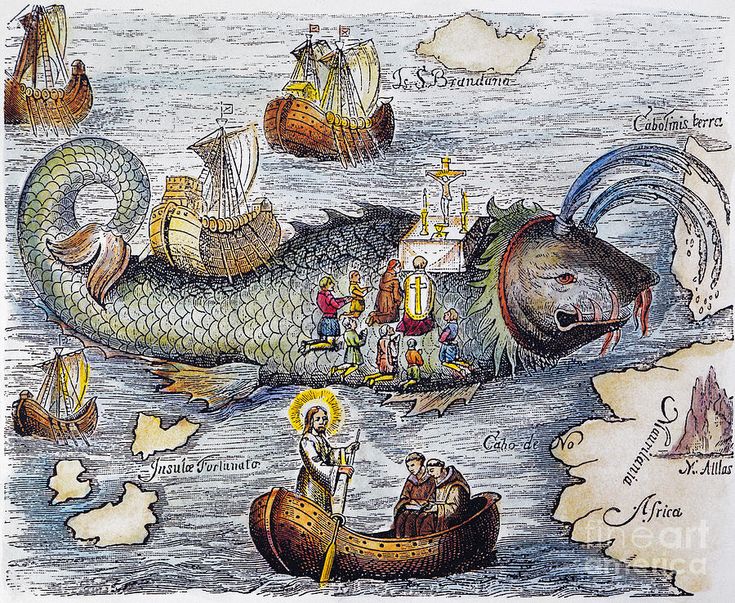
One of the most captivating stories from Brendan’s voyage is the Easter celebration on the back of a whale. According to the tale, Brendan and his crew, unable to find land during Easter, landed on a small island to hold Mass. As they concluded the service, the island began to move and they realized they had been on the back of a giant sea creature, presumably a whale.
The climax of St. Brendan’s voyage was the discovery of the Land of Promise. This land, as described in the Navigatio, was a paradise filled with lush vegetation, abundant flowers, and rich fruits. After spending forty days exploring this land, an angel appeared to Brendan and told him to return to Ireland. The angel informed Brendan that the Land of Promise would remain hidden until the end of time.
Following his epic voyage, St. Brendan returned to Ireland where he continued his ecclesiastical work. His accounts of the voyage spread far and wide, inspiring numerous manuscripts and adaptations.
You can also read the entire work about St. Brendan’s voyage HERE
So again, why is this story important, and what does it have to do with the Christian calendar. What we will immediately ask as modernists is, “did it really happen?” Of course we do, because if we cannot verify the historicity then it has no value to us. But in doing so, we miss out on how humanity has understood the purpose of the story. Not primarily for conveying how things actually happened, but conveying how things actually are; which is very much by definition what the parables of Christ are. This is something that both Tolkien and Lewis, likewise built their works around; some more on the nose like Lewis’ Narnia, but undeniably, the Lord of the Rings is doing the same thing in a different way.
When you read the Voyage of St. Brendan the Abbot, it is not just a seafaring adventure. The punctuated events of the story where the miraculous and amazing take place are during the different feasts and celebrations of the Church year. The celebration of the Pascha Vigil happens on the back of what modern people presume is a whale, and other key events happen on other feasts such as Pentecost.
In St. Brendan and his companions’ journey towards the beautiful and blessed land they were told of is very much like a parable of the Christian life. An early Celtic Christian version of Pilgrims Progress in its own right. Whether or not the journey happened is beside the point (as always these things have at minimum a core of truth is not the whole thing), but its importance comes in telling the reader how in the unknown and wild sailing through life that we all experience, there is something about coming to those places in commemoration of the work of Christ that allows the journey to continue.
So what does this mean for us Christians today? Well, we certainly cannot totally get rid of our secular national calendar; but it does mean maybe the calendar of our faith should supplant its supremacy in our lives. Why do we so often get so excited for Christmas? Well, because of the family, food and gifts. And yes, it is the celebration of the incarnation of Christ; but in reality it sometimes becomes secondary. Or what about Easter? Without doubt the MOST important date on the Christian calendar where His glorious resurrection took place, sealing His victory over sin and death on our behalf. We sometimes put it in second place to Christmas, while still talking about its importance.
But when the Christian calendar, the constant flow of the Gospel story through every year becomes the cornerstone of how we reckon our lives, something is different. Not at first. You might not fully see anything different the first few years of living this way (a place that I am still in). But what happens after maybe 4 or 5 years of centering your life around the Gospel is that you see how you are different as you continually encounter Christ on your way to that blessed land promised to the Saints.

by Joel V Webb | Oct 12, 2026 | Uncategorized
There’s a joke of a conversation between a husband and wife talking about where they want to go for their date night. The husband promises his wife, after telling her to get all gussied up that it will be an expensive place. And they go to a gas station.
Outside of a joke about the universal understanding that the price of gas is always too high, we also tacitly grasp the reality that a date at a gas station may have its issues. I am not saying that there are no situations in which a gas station date isn’t unique, necessary, or is something that makes a memorable time together when you think back on it. What I am saying is that beyond moving beyond initial objections you begin to realize that questionable sushi, slushies, corn dogs and dry pizza that all tastes of the overly processed ingredients in it is not what one thinks of when you talk about going on a date.
When it comes to the worship of the Church, especially surrounding the Sacraments, there has been a tendency, especially since COVID to hold up pragmatism and simplicity as the highest objective. This is demonstrated most profoundly and sadly in the Evangelical realm surrounding the celebration of the Lord’s Supper.
I grew up being used to taking one of the little plastic cups from the tray, and a piece of broken matza bread whenever we celebrated communion (once a month at the church my dad pastored). But something has dramatically changed in the last five plus years. While the little prepackaged communion cups had already existed, COVID threw them to center stage as the best option for churches to celebrate communion with the lowest possible chance of passing on the plague.
While the momentary reasons for its use have passed, yet the use of these little cups has persisted. It’s easy to buy a box of 1000 of them, pass them out, or set them in a basket to do communion and then throw them out. No prep time, lower chance of spills, and the ease of them. But we never seem to ask what we lose when we go this route?
There are multiple things I am thinking of that are lost when we celebrate the memorial of our redemption in this way, but what I want to reflect on here is the fact of beauty. This reality of beauty is one of the last asked questions in the modern Evangelical space, and I am increasingly saddened by it. The church use to be known for reflecting the beauty of God in creation through our construction and ceremony. But in the last several generations especially that has been discarded.
When we replaced precious metal, wood or pottery chalices filled with the fruit of the vine and plates with hosts or bread to mini-disposable communion cups with highly processed elements, it visibly screams that matter doesn’t matter. There is something wonderful about a community gathering around a single table where the words of St. Paul are enacted when he wrote “Because there is one loaf, we, who are many, are one body, for we all share the one loaf.” (1 Cor. 10:17) Rather, in our Modern Western ideal, we celebrate together but individually separated by our own, fast-food packaged elements.
Of course there is more that could be said about this, and I certainly did not contextualize everything to the extent some would want; but I think my point is clear. Individual, prepackaged communion cups are by no means sinful. But they do reflect a tendency in modern Evangelicalism to trend towards the disposable and easy at the loss of other things that the Church has valued since its founding.
by Joel V Webb | Oct 5, 2026 | Free Methodism, Methodism, Resources, Theology & Practice
Anyone who has known me for the last few years knows that I am a nerd, especially when it comes to all things liturgical. To highlight this, during the past weekend a pastor friend sent a message asking about why the lectionary readings between the Book of Common Prayer she uses, and the Lectionary readings in her worship planner from Seedbed (Which uses the Revised Common Lectionary) are different. I then proceed to send a 4 minute voice memo about the variances between the ACNA Lectionary and RCL and the developments that brought them to their current forms. So, maybe my knowledge is super specialized and more than I actually need to know; but I enjoy it.
Last week I was very excited that the Global Methodist Church revealed its new draft liturgies for Baptism, Communion and membership/confirmation/baptismal reaffirmation. I knew they were on the way as I am connected to several of those involved in their development and had several inklings as to what they would look like. The liturgies are available for download HERE and they are in a 3-month period of open commenting for suggestions of changes and adjustments.
In the introduction to the document, the Chair of the Liturgy Task Force, Dr. Tesia Mallory who also serves as the Dean of Chapel at Asbury Theological Seminary writes, “At its core, liturgy is the Church’s communal prayer and conversation with God. We believe that our practices of prayer shape what we believe, and what we believe shapes how we live as faithful followers of Jesus. In light of this, we offer this draft resource as a means of honoring Christ in our mission to spread scriptural holiness across the globe through the worship life of The Global Methodist Church”
One of the things we fail to see in our day and age is that worship is formative. Worship is not just the songs we sing, it is every part of our gathered times on Sunday, and every thing we do from the Scriptures we read, the silence we keep, the actions and posture of our bodies, and then the music we sing is a part of worship. This more holistic vision of what worship is, of course includes the summit of it which is celebration of the Eucharist makes how we are formed and give God what He is due a much richer reality than the sickly and myopic picture we often put ourselves in.
In conversations about the liturgies in the lead up to their release, one of the comments concerning them was that they would be the Book of Common Prayer that is contextualized for Methodist worship. And, when you think about it, that is very appropriate. The Methodist tradition gains much when we look back to our Anglican heritage; something that has often been left behind for American Methodists.
I’ll save specific comments about the liturgies for an upcoming podcast episode interviewing some of the members of the liturgy task force. What I will say is that these liturgies have done the solid work of recovery. For anyone familiar with the Book of Common Prayer (especially the 2019 published by the ACNA), there is a lot of material that will feel familiar. The biggest reclamation of these liturgies are the Sacramental elements that have been mostly issued the last several generations in Methodism. The prayer of blessing over the water, anointing of oil/chrism after baptism, What I found to be a wonderful Methodist addition to the baptism liturgy was the Wesley Covenant prayer following the baptism, said by all as a collective affirmation to Christ.
Similarly, in the communion liturgy the use of an explicit epiclesis (invoking of the Holy Spirit upon the elements) and the Prayer of Humble Access (rather than something like a “Prayer for Spiritual Communion”) really land the participant into the gravity and beauty of what happens when we come to the table and encounter Christ as He is revealed in the breaking of bread.
While these liturgies are from the Global Methodist Church, they represent a resource and a sign for the rest of us in the pan-Methodist world as the orthodox core of our heritage is being reconstituted, and the spiritual descendants of Wesley are striving to revive the heart of our movement; a Church that is set on fire by the holy love of God to spread Scriptural holiness across the land.
What should these draft liturgies mean for the Free Methodist Church (my ecclesial home) and other pan-Methodist denominations? We should not delay by our varying capacities to make liturgical adjustments ourselves. This of course is easier said than done, and even ironic in the case of the FMC where liturgy in the same sentence looks like spelling a word with the English “u” in color or something like that.
At this point what is undeniable is the draw for the younger generations is the rooted grounding of liturgy, Sacraments and not being catered to. Something that is sadly confounding to the “boomer generation” who is still seeking to be relevant to the “fellow kids” in the hopes of drawing them. Rather, we need to reclaim as the GMC is doing, not for the sake of loving antiques, but by coming back to the heart of why we gather. Recounting and participating in the ongoing work of Christ in the Gospel which is the power of God.
As of now the Communion Ritual in the FMC Book of Discipline 2023 is a bit like a house originally built in the 1800’s and then has had 4 or 5 additions put on. The Lord’s Prayer is tacked on as an extension of the confession (something very strange, especially considering how Cranmer used the Our Father as a post-communion prayer. Similarly, the language of the “Prayer for Spiritual Communion”takes an almost anabaptist approach to understanding the Real Presence of Christ in the elements.
Supposedly there are big changes coming to the Free Methodist Church. We have no idea what they are because no one in the know has publicly said anything that actually lets us know what is happening. But, I would add to the list of things to adjust or change is revamping our liturgies for baptism and communion to reflect this reclamation of our heritage as we seek to become the Church that is not thrown about by the winds of the time and is rather seen as a steadfast rock (ultimately Christ) that those battered about can cling to.

by Joel V Webb | Sep 28, 2026 | History, Methodism, Sacraments, Theology & Practice
In the study of the theology and practice of John Wesley one of the most evident realities was the very high place that John placed on the Sacraments. When you survey his journals it is obvious he celebrated the Lord’s Supper multiple times as week, and it became a cornerstone of the practice of the early Methodists so much so that it played a part in reshaping how often Communion was celebrated in Anglican parish life from as little as only a couple times a year (usually quarterly) to weekly.
But when it comes to the actual practice of the Methodist societies, class and band meetings, they are seemingly silent on their practice in those settings. While many a modern reader would take this silence to make it seem they were unimportant, I think when you read between the lines, a different story comes to bear. This question was recently pointed out to me by Rev. Dr. Doug Cullum, now retired pastor and faculty from Northeastern Seminary at Roberts Wesleyan University in Rochester New York.
We first need to work from the presupposition that Wesley did not set out to start a church. He was, in fact, a churchman in the Church of England, and remained so for the entirety of his life (something his brother Charles held strongly to as well). And, it wasn’t until the last few years of John’s life that a communion table was even present in one of the established Methodist gathering places.
This silence then is not because the Sacraments of Baptism & the Lord’s Supper were unimportant. Contrarily, they were seen as essential! But the nature of this silence or deficiency seems to be intentional, and it is from this place that we can come to understand the original purpose of Methodism.
John & Charles saw the Methodist movement as a renewal movement within the Church, not as a separate ecclesial movement. So with this in mind you can then see what this “sacramental deficiency” existed. Any Methodist society, class or band was for the spiritual growth of the individual to then go and be active and spiritually alive in the context of their local parish. It was then there where they were to receive the Lord’s Supper as often as it was offered, and to have their children baptized.
It was only when the Methodist movement, specifically in the American context became its own mother church in 1784 did the sacramental practice pass from the Anglican clergy to their own appointed and installed Elders. But what has happened over the last few centuries, as often does with the passing of time, is the loss of the context that provided the basis of understanding what was actually going on on that day.
If we look and see the lack of sacramental practice within early Methodism as an argument from silence, that the Evangelical focus that we are all familiar with was the sole focus, we then lose the full picture of who Wesley was, and the intent for what the Methodist movement was all about.
When you place the original Methodist movement within the context of an already existing parish system where the adherents of society, class and band meetings were already apart of, then it all clicks into place. What could be seen as intentional neglect or unimportance becomes in fact intentional deficiency; where the Sacramental need was already fulfilled in the churches these people were already members of.
What this then means for all forms of Methodism in the 21st Century, which now represent the status of “Mother Churches”, no longer a separate movement within an ecclesial body, but ecclesial bodies of their own is then the responsibility to faithfully administer the Sacraments of Christ. Baptism following birth or conversion, and the Lord’s Supper, weekly or more often as Wesley intended for his followers to partake.
It is this reality, both the Sacramental and the Evangelical that the Methodist movement holds in tension. Not in a contrary way, but in an complimentary way, understanding both for the need of the supremacy of the Word of God to drive us to personal relationship with Christ, and for Christ to then welcome us in through Baptism, and then continually feed us as He promised at the Table where He is both host and feast.
That is the picture of Methodism that Wesley intended for his descendants, a heritage we must reclaim and live in to.

by Joel V Webb | Sep 24, 2026 | Free Methodism, History, Methodism, Orthodoxy Matters, Sacraments, Theology & Practice
The following article, written by Free Methodist Bishop Emeritus Paul N. Ellis, presents a vigorous historical and theological case for the baptism of infants and young children within the Free Methodist tradition. Ellis argues that parents dedicate their children to God, while the church receives those children through baptism as members of the covenant community and pledges their Christian nurture.
Readers should approach the essay as a historical document and a constructive theological argument. Its language reflects the concerns and ecclesial debates of its original setting, especially the question of whether Free Methodists should replace infant baptism with child dedication.
The contemporary Free Methodist Church continues to affirm baptism as a sacrament and means of grace, and its Articles of Religion state that infants may be baptized at the request of parents or guardians who promise Christian formation. At the same time, current Free Methodist pastoral practice commonly recognizes parent-led infant dedication as an available alternative. The article below represents Ellis’s argument for recovering a stronger covenantal and sacramental practice of infant baptism.
This article was originally published in The Free Methodist Pastor, Summer 1983. is stored, and was scanned by the Marston Memorial Historical Center. You can read the original scanned article HERE
Parents Dedicate, the Church Baptizes
Paul N. Ellis, Bishop Emeritus
Winona Lake, Indiana
I have in my possession The Discipline of the Free Methodist Church, 1874, published fourteen years after the founding of our denomination. Article XVIII of the Articles of Religion includes the following constitutional guarantee:
“The baptism of young children is to be retained in the Church.”
From the beginning until 1974, this statement concerning the baptism of children was the denomination’s position.
In 1974, a new Constitution was adopted by the General Conference and ratified by the annual conferences. The new Constitution provided a fuller explanation of our historic position. Regarding baptism as a sacrament, Article XVII states:
“We believe water baptism and the Lord’s Supper are the sacraments of the church commanded by Christ. They are means of grace through faith, tokens of our profession of Christian faith, and signs of God’s gracious ministry toward us. By them, he works within us to quicken, strengthen, and confirm our faith.”
Regarding the baptism of young children, Article XVII affirms:
“Baptism is a symbol of the new covenant, and since infants are recognized as being included in the atonement, we hold that they may be baptized upon request of parents or guardians who shall give assurance for them of necessary Christian training. They shall be required to affirm the vow for themselves before being accepted into church membership.”
Accordingly, the bishops have made it clear to pastors that ministers violate their vows of ordination in the Free Methodist Church if they refuse to administer baptism to infants or children upon the request of parents or guardians. This is the historic position of the church.
Wesley’s View
The founders of Free Methodism, who felt called to “return to early Methodism,” agreed with Wesley on baptism.
In his Works, Wesley included “A Treatise on Baptism,” in which he wrote:
“By baptism we enter into covenant with God; into that everlasting covenant, which he hath commanded forever, that new covenant, which he promised to make with the spiritual Israel. . . . And as circumcision was then the way of entering into this covenant, so baptism is now. . . .
“Therefore, it is not only lawful and innocent, but meet, right, and our bounden duty, in conformity to the uninterrupted practice of the whole Church of Christ from the earliest ages, to consecrate our children to God by baptism, as the Jewish Church was commanded to do by circumcision.”
See Burtner and Chiles, A Compend of Wesley Theology (New York and Nashville: Abingdon Press, 1944), 266–68.
Inferences From Scripture
We must not forget that the Church of Jesus Christ from its beginning was—and remains—a covenant church, even as Israel was a covenant nation.
In Jeremiah’s promise of “a new covenant,” the prophet declares:
“Behold, the days come, saith the Lord, that I will make a new covenant with the house of Israel, and with the house of Judah” (Jer. 31:31).
The author of Hebrews identifies this new covenant with Jesus:
“Jesus is the mediator of the new covenant” (Heb. 12:24).
There is no dispute that circumcision was, and remains, the sign of the covenant relationship between God and Israel. An adult proselyte entering Judaism must be circumcised. Those born into Judaism, however, are circumcised on the eighth day after birth. The rite acknowledges the ancient covenant among faithful Jews.
In the New Testament, the recorded conversions and baptisms of households strongly imply the inclusion of children. Peter declared:
“The promise is unto you, and to your children” (Acts 2:39).
He did not qualify “children” with the adjective adult. Such a qualification would have seemed unnecessary to the early church, whose members were steeped in the tradition of family unity in matters of religion.
When Paul and Silas were released from the Philippian jail, we read:
“And he [the jailer] took them the same hour of the night, and washed their stripes; and was baptized, he and all his, straightway” (Acts 16:33).
Given the nature of family life in that day, one might expect a specific exception for “infants and young children” if Paul had intended to exclude children from the sacrament.
The classical statement in our baptismal ritual concerning the church’s acceptance of children in baptism is found in the words of Jesus:
“And they brought young children to him, that he should bless them; and his disciples rebuked those that brought them. But when Jesus saw it, he was displeased, and said unto them, ‘Suffer the little children to come unto me, and forbid them not; for of such is the kingdom of God’” (Mark 10:13–14).
A Methodist Scholar Speaks
Addressing the church’s responsibility to receive into its fellowship all those for whom Christ died when they themselves cannot yet make a choice, Olin Alfred Curtis writes:
“The church of our Lord has the right and the duty to claim the helpless. She should take into her atmosphere and association and, if possible, service all people who are unable to make a choice for themselves; not only all irresponsible children, but all the feeble-minded, and all those unfortunate souls who have been mentally wrecked by woes too terrible for human fortitude.”
Curtis describes this group as members “by Christian claim.”
He continues:
“If you ask what infant baptism precisely stands for as a rite, the answer should, I believe, be this: It stands for the sacramental acceptance by the church of the consecration unto Christ of a babe by a home.”
See Olin Alfred Curtis, The Christian Faith (Grand Rapids, MI: Kregel Publications, 1956), 420–21, 438.
A Presbyterian Scholar Speaks
John Frederick Jansen asks:
“Must a child be outside the church? Does not Baptism rather say that from earliest infancy I am brought into the environment of grace and receive the seal of God’s love? Of course an infant does not feel any effect. But who is to say how soon a child becomes aware of love, and why not divine love?
“What shall the church say to its children? Shall it forbid them Baptism? Shall it assume that there is no such thing as a Christian child? Are children outsiders in the church, or are they members of the household of faith? If the old Israel included its children in the family of faith through circumcision, shall the new Israel exclude them?”
See John Frederick Jansen, The Meaning of Baptism (Philadelphia: Westminster Press, 1948), 102, 108.
Some Personal Observations
- Baptism does not regenerate either adults or children. For an adult believer, baptism is a sign of the covenant of grace entered into by faith; a public confession that the believer trusts in Christ’s atoning work for salvation; and a means of grace. For an infant, baptism is likewise a sign of the covenant of grace and a confession by the parents and the church that children are saved—not because they are innocent, but, as are all people, because of the universal atonement made by Christ for the human race. I also believe strongly that baptism is a means of grace to the child. Do we not pray for our children? Do we not anoint them with oil for healing? Should we think grace is given only to persons old enough and rational enough to understand fully the sacrifice of Jesus Christ? If so, who may be baptized? Who understands it fully?
- Parents dedicate the child; the church baptizes the child. Dedication is made by the only persons who can give a child to God: the parents. In baptism, the church accepts the child in a formal yet spiritual manner and pledges, in cooperation with the parents, to confirm that child in the Christian faith. It is meaningless for the church to assume that it can dedicate a child whom it has not accepted into the family of God.
- The Free Methodist Church historically stood within the classical catholic tradition of baptizing children. Until comparatively recent years, the Free Methodist Church stood alongside the Roman Catholic, Eastern Orthodox, Episcopal, Reformed, Presbyterian, Methodist, and other churches of Catholic, Calvinian, Arminian, and Wesleyan traditions in recognizing the baptism of children as a valid sacrament of the Church of Jesus Christ. Today, we are being influenced, to our loss, by Baptistic branches of the church, including the Churches of Christ.
- Replacing baptism with dedication departs from Free Methodist intention and doctrine. In my opinion, Free Methodist pastors who persuade members to have their children “dedicated” rather than baptized turn away from the intention of our founding fathers, fail to transmit the letter and spirit of our Articles of Religion, and miss a significant opportunity to witness to the covenant character of the church.
- The New Testament church was not merely a believers’ church. It was—and continues to be—a covenant church. It receives believing adults into its fellowship, as Judaism has always done, but it also includes the whole Christian family until, if it should occur, a growing child turns away from that fellowship in unbelief, just as an adult may do.
- The nurture of children is therefore of supreme importance. We believe that a child’s confession of Christ as Savior—even at four or five years of age, or perhaps younger—can be valid. Therefore, we have a solemn responsibility to confirm our children in the Christian faith, guide them in Christian love, and bring them to an adult experience of Christ through the revelation of the Holy Spirit. The vows of adult baptism and church membership can become meaningful to a child who is assured that the church has received him or her from infancy into the loving family of God.