Anyone who has known me for the last few years knows that I am a nerd, especially when it comes to all things liturgical. To highlight this, during the past weekend a pastor friend sent a message asking about why the lectionary readings between the Book of Common Prayer she uses, and the Lectionary readings in her worship planner from Seedbed (Which uses the Revised Common Lectionary) are different. I then proceed to send a 4 minute voice memo about the variances between the ACNA Lectionary and RCL and the developments that brought them to their current forms. So, maybe my knowledge is super specialized and more than I actually need to know; but I enjoy it.
Last week I was very excited that the Global Methodist Church revealed its new draft liturgies for Baptism, Communion and membership/confirmation/baptismal reaffirmation. I knew they were on the way as I am connected to several of those involved in their development and had several inklings as to what they would look like. The liturgies are available for download HERE and they are in a 3-month period of open commenting for suggestions of changes and adjustments.
In the introduction to the document, the Chair of the Liturgy Task Force, Dr. Tesia Mallory who also serves as the Dean of Chapel at Asbury Theological Seminary writes, “At its core, liturgy is the Church’s communal prayer and conversation with God. We believe that our practices of prayer shape what we believe, and what we believe shapes how we live as faithful followers of Jesus. In light of this, we offer this draft resource as a means of honoring Christ in our mission to spread scriptural holiness across the globe through the worship life of The Global Methodist Church”
One of the things we fail to see in our day and age is that worship is formative. Worship is not just the songs we sing, it is every part of our gathered times on Sunday, and every thing we do from the Scriptures we read, the silence we keep, the actions and posture of our bodies, and then the music we sing is a part of worship. This more holistic vision of what worship is, of course includes the summit of it which is celebration of the Eucharist makes how we are formed and give God what He is due a much richer reality than the sickly and myopic picture we often put ourselves in.
In conversations about the liturgies in the lead up to their release, one of the comments concerning them was that they would be the Book of Common Prayer that is contextualized for Methodist worship. And, when you think about it, that is very appropriate. The Methodist tradition gains much when we look back to our Anglican heritage; something that has often been left behind for American Methodists.
I’ll save specific comments about the liturgies for an upcoming podcast episode interviewing some of the members of the liturgy task force. What I will say is that these liturgies have done the solid work of recovery. For anyone familiar with the Book of Common Prayer (especially the 2019 published by the ACNA), there is a lot of material that will feel familiar. The biggest reclamation of these liturgies are the Sacramental elements that have been mostly issued the last several generations in Methodism. The prayer of blessing over the water, anointing of oil/chrism after baptism, What I found to be a wonderful Methodist addition to the baptism liturgy was the Wesley Covenant prayer following the baptism, said by all as a collective affirmation to Christ.
Similarly, in the communion liturgy the use of an explicit epiclesis (invoking of the Holy Spirit upon the elements) and the Prayer of Humble Access (rather than something like a “Prayer for Spiritual Communion”) really land the participant into the gravity and beauty of what happens when we come to the table and encounter Christ as He is revealed in the breaking of bread.
While these liturgies are from the Global Methodist Church, they represent a resource and a sign for the rest of us in the pan-Methodist world as the orthodox core of our heritage is being reconstituted, and the spiritual descendants of Wesley are striving to revive the heart of our movement; a Church that is set on fire by the holy love of God to spread Scriptural holiness across the land.
What should these draft liturgies mean for the Free Methodist Church (my ecclesial home) and other pan-Methodist denominations? We should not delay by our varying capacities to make liturgical adjustments ourselves. This of course is easier said than done, and even ironic in the case of the FMC where liturgy in the same sentence looks like spelling a word with the English “u” in color or something like that.
At this point what is undeniable is the draw for the younger generations is the rooted grounding of liturgy, Sacraments and not being catered to. Something that is sadly confounding to the “boomer generation” who is still seeking to be relevant to the “fellow kids” in the hopes of drawing them. Rather, we need to reclaim as the GMC is doing, not for the sake of loving antiques, but by coming back to the heart of why we gather. Recounting and participating in the ongoing work of Christ in the Gospel which is the power of God.
As of now the Communion Ritual in the FMC Book of Discipline 2023 is a bit like a house originally built in the 1800’s and then has had 4 or 5 additions put on. The Lord’s Prayer is tacked on as an extension of the confession (something very strange, especially considering how Cranmer used the Our Father as a post-communion prayer. Similarly, the language of the “Prayer for Spiritual Communion”takes an almost anabaptist approach to understanding the Real Presence of Christ in the elements.
Supposedly there are big changes coming to the Free Methodist Church. We have no idea what they are because no one in the know has publicly said anything that actually lets us know what is happening. But, I would add to the list of things to adjust or change is revamping our liturgies for baptism and communion to reflect this reclamation of our heritage as we seek to become the Church that is not thrown about by the winds of the time and is rather seen as a steadfast rock (ultimately Christ) that those battered about can cling to.
A few months ago I was accused of mocking. In this particular instance, I would say it was a quick attempt a labeling, a response that it often utilized as a way to write off, and side skirt whatever issue is the topic at hand. In this article we are going to start to develop something of a theology of righteous mocking or scoffing. Why would we even do that? Because like many things that we find in Scripture, there are emotions or actions that can be done correctly, and incorrectly. One major example that people often think of is anger. In modern American Christianity we often instantly associate anger with totally being bad, and thus a sin. But the Scriptural picture is much more nuanced than that. There are several examples presented to us of someone being angry, and it was wholly justified, even righteous. One prime example that we can often think of is Jesus when He cleanses the Temple just days before His crucifixion.
Then Jesus entered the temple area and drove out all those who were selling and buying in the temple courts, and turned over the tables of the money changers and the chairs of those selling doves. 13 And he said to them, “It is written, ‘My house will be called a house of prayer,’ but you are turning it into a denof robbers!” (Matthew 21:12–13, NET 2nd ed.)
There is no way around it in this passage. Jesus is angry, and righteously so. His Father’s house has been defiled by overcharging, and the Court of the Gentiles has been converted from its intended usage of allowing non-Jews to worship the True and Living God, and is being used to extract as much money as possible. Because of this, I think every honest Christian agrees that Jesus is righteously angry.
So now, back to scoffing and mocking. Like anger, this can be done rightly, but we must be so careful, because Scripture does warn about scoffing and mocking. “How blessed is the one who does not follow the advice of the wicked,or stand in the pathway with sinners, or sit in the assembly of scoffers. (Psalm 1:1, NET 2nd ed.). As followers of Christ we must be careful to not be a scoffer by character or reputation. Scoffing is something that can so easily be done incorrectly, and just fall into a mentality of mocking everything. Proverbs paints the scoffer as proud, resistant to correction, and destructive to community life (Prov. 9:7–8; 21:24). In the New Testament, scoffers are those who deny God’s promises and mock His people’s hope (2 Pet. 3:3–4; Jude 18).
This is no small matter. Scoffing is not just a bad habit of speech; it reveals the condition of the heart. To mock truth, holiness, or God’s promises is to place oneself in opposition to Him. For this reason, Christians are urged to avoid contemptuous ridicule and to let their words instead be gracious, seasoned with salt (Col. 4:6).
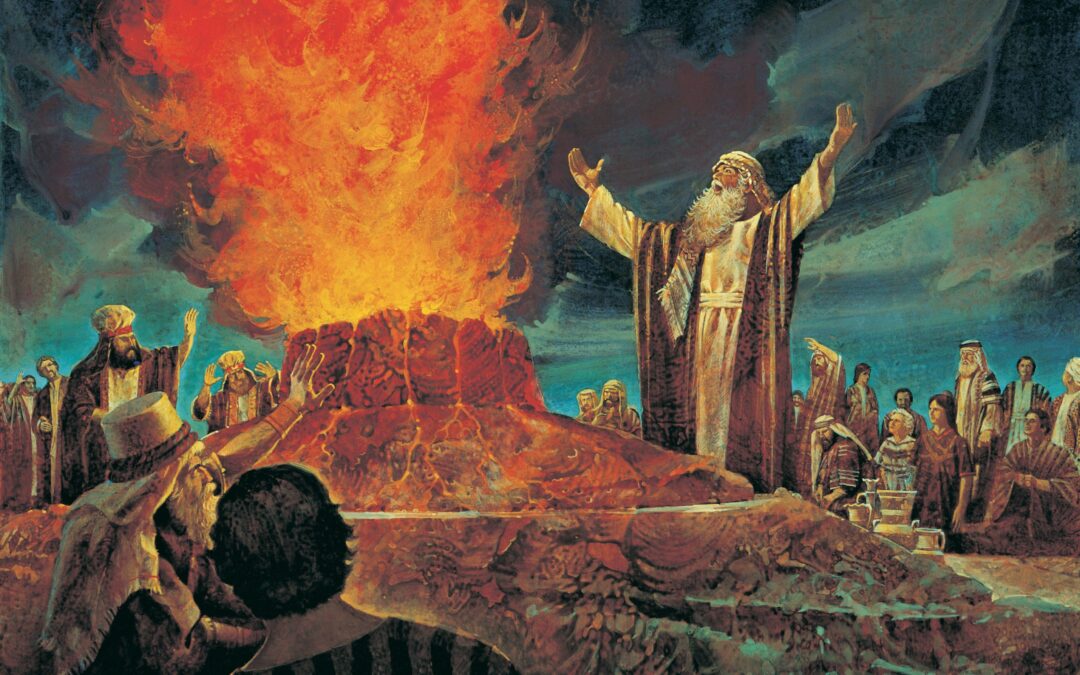
A striking biblical example of this kind of righteous mockery is found in Elijah’s confrontation with the prophets of Baal on Mount Carmel. As they cried out and cut themselves in a desperate attempt to rouse their god, Elijah began to taunt them: “Shout louder! Perhaps he is a god, but he may be deep in thought, or busy, or traveling. Perhaps he is asleep and needs to be awakened” (1 Kings 18:27). This is not petty ridicule; it is prophetic exposure. Elijah’s words highlight the impotence and absurdity of Baal, contrasting sharply with the living God who answers by fire. His mockery is aimed not at the personal weakness of the prophets, but at the falsehood they represent and the spiritual deception they perpetuate. In doing so, Elijah cuts through the illusion of power surrounding Baal worship and calls the people of Israel back to reality: a god who must be awakened, entertained, or persuaded is no god at all.
The same pattern appears in the wider tradition of the Church. Consider St. Boniface, who famously cut down the sacred oak of Thor at Geismar, not merely as an act of destruction, but as a lived argument, an embodied mockery of pagan impotence when no divine retribution followed. Likewise, the Church Fathers often employed sharp, even biting rhetoric to expose the absurdity of idolatry and false worship. Justin Martyr ridiculed the idea that gods could be fashioned by human hands and then worshiped, while Tertullian sarcastically pressed pagan critics by pointing out the moral contradictions in their own myths and practices. Even Augustine, with his characteristic wit, mocked the Roman gods in The City of God, highlighting their moral failings and the irrationality of trusting them. In each case, the aim was not cruelty, but clarity: to strip false religion of its perceived power and dignity, revealing it as hollow so that the truth of the living God might stand all the more plainly.
There is a correct way to scoff. There are seven principles found in Scripture when it comes to scoffing that keep it in the bounds of righteously doing so correctly. As we will see, mockery is always ultimately done out of the context and foundation of love. This is especially applicable when there are those who are being hurt or led astray by spiritual leadership, or wrong ideologies.
Aim mockery at power, not the vulnerable.
Target: false teachers, abusive leaders, oppressive systems. Never those sincerely struggling, doubting or deceived.
Example: Jesus mocked Pharisees (Matt. 23), but gently restored the confused and broken. (John 4 & 8)
Expose Absurdity, Don’t Just Insult
Mockery should unmask lies by showing their foolishness.
Example: Elijah mocking Baal’s prophets (1 Kings 18:27). His sarcasm made their god look ridiculous, not just insulting them personally.
Check Your Motives
Ask: Am I doing this to protect the flock and glorify Christ, or to boost my ego?
Wrong motive = you become the scoffer condemned in Proverbs (Prov. 21:24).
Keep the Gospel Centered
Satire without truth just tears down. Always point back to Christ as the true alternative.
Example: Paul mocks false apostles (2 Cor. 11:19–20) but immediately re-centers the church on the true gospel.
Use It Sparingly and Strategically
Righteous ridicule is a scalpel, not a sledgehammer.
If every sermon, post, or conversation drips with sarcasm, you risk cynicism.
Example: Jesus rarely used biting mockery—He saved it for entrenched hypocrisy (Matt. 23, Luke 11:37–54).
Make the Falseness Obvious
Highlight contradictions, exaggerations, or hypocrisy.
Example: Isaiah 44:14–20 ridicules idol-makers: burning half a log for firewood while worshipping the other half. The point is crystal clear—idols are absurd.
Be Willing to Weep as Well as Mock
Prophets wept even as they derided falsehood (Jer. 9:1).
Mockery without compassion risks becoming cruelty.
These guidelines laid out are also included in the attached graphic.
So the question is why should Christians know the guidelines of how to correctly scoff or mock? Because in cases of aberrant theology, abusive leadership, or abhorrent evil, mocking and scoffing can be an effective tool at cutting through whatever veil of power or superiority is present in a conversation, especially when there is a huge power differential. The difference lies in intent. Sinful scoffing flows from pride and aims to humiliate. Righteous mockery flows from zeal for God’s glory and aims to expose folly so that repentance might be possible. This means that for most of us, most of the time, scoffing should be avoided. But on rare occasions, in moments of prophetic confrontation, sharp words may be necessary to defend truth and unmask lies.
Of course, objections come quickly. Isn’t mockery unloving? Shouldn’t Christians be humble? Won’t it push people away? These are important questions, and they remind us that mockery is not a tool to be used lightly. Love usually speaks gently. Humility usually refrains from biting words. But sometimes love requires severity, and humility means trusting God enough to call sin what it is.
As a pastor, I find this both challenging and liberating. Challenging, because it calls me to examine my heart before I speak. Am I exposing falsehood for God’s sake, or am I indulging in sarcasm to make myself look clever? Liberating, because it reminds me that God’s people are not called to be endlessly polite in the face of evil. We are called to speak the truth in love, and sometimes love has a sharp edge.
Most of the time, our call is to bless those who mock us and to endure patiently, following Christ who “did not revile in return” (1 Pet. 2:23). But in those rare moments when the honor of God is at stake, Christians may find themselves called to words that cut, not to destroy, but to heal; not to humiliate, but to awaken.
A while ago I wrote about utilizing the Lectionary for preaching. This ancient tool provides Scriptures for every Sunday of the Church year, each passage carefully selected to guide the Church through the rhythms of Christ’s life and the great mysteries of the gospel. At its best, the lectionary is not just a schedule—it’s a theological lens. It draws us into a way of reading Scripture that aligns our hearts with the seasons of the Church, shaping how we pray, how we worship, and even how we understand the story of redemption as it unfolds across the pages of Scripture.
During Lent, for instance, we hear readings that focus on Christ’s ministry as He moves steadily toward His Passion. The texts remind us of His temptation, His preaching on repentance, and His resolute journey to the Cross. These aren’t random selections—they’re intentionally chosen to form us in penitence, humility, and renewed devotion. And now, in Advent, the readings point us toward watchfulness and hope. They remind us of God’s promises, the prophets’ longing, and the call to prepare our lives for Christ’s coming—both His first coming in Bethlehem and His return in glory. When used well, the lectionary doesn’t just tell the story of salvation history; it invites us into it.
Most churches today that follow a lectionary use a three-year cycle—Years A, B, and C. This pattern is a relatively modern innovation, developed after Vatican II and adopted by many Protestant denominations as well. The idea was simple: expand the range of Scripture heard on Sundays so that congregations would receive a broader diet of biblical passages. With concerns about growing secularism, biblical illiteracy, and the increasingly thin scriptural foundation in Western culture, this seemed like a noble and necessary move.
Historically, however, the Church used a one-year cycle that repeated annually. Each new Church year started with Advent, and the readings cycled through the same appointed lessons every year. The repetition was intentional. The Church believed that spiritual formation happens through immersion, not novelty—through hearing the same words again and again, in the same seasons, until they become part of the Christian imagination.
So why did many churches move to a three-year cycle? Part of the answer has to do with changes in everyday life. For centuries, the primary place believers heard large amounts of Scripture wasn’t Sunday morning—it was the daily prayer offices, especially Morning and Evening Prayer. Through these, the entire Bible was read in the course of a year. But as the pace of life accelerated and the daily offices fell out of regular use for many, Sunday morning became the main (and for some, the only) time people regularly encountered Scripture. The three-year lectionary was an attempt to compensate for that loss.
But good intentions do not always yield the outcomes we expect. While the breadth of Scripture increased, something subtle but significant was lost: depth.
Three years is simply too long for the average congregation to hold a unified scriptural rhythm in memory. The seasonal themes become stretched thin. The passages don’t repeat often enough to become familiar, let alone formational. A reading heard only once every three years might be interesting or enlightening in the moment, but it rarely has the opportunity to sink in, to reappear in prayer, or to become a recurring voice shaping our lives.
The older one-year lectionary, by contrast, offered a formative repetition that acted like liturgical catechesis. Every Advent, you encountered Isaiah’s promises. Every Lent, you heard the same calls to repentance and the same foreshadowing of the Passion. Every Easter, the same readings shouted the resurrection hope of the gospel. Over years of worship, these passages became companions—scriptures that lived in the heart, surfaced in difficulty, and formed the backbone of a believer’s biblical memory.
This is why many people who grew up with the one-year cycle can recall certain readings with remarkable clarity. They don’t remember them because they studied them in a classroom; they remember them because they prayed them, sang them, and heard them proclaimed every year. The repetition shaped not only what they believed, but how they believed it.
In the end, this is what the lectionary is meant to do. It is not merely a reading plan. It is a tool for communal formation. It shapes the imagination of the Church, builds a shared scriptural vocabulary, and roots our worship in the story of Christ from Advent through Pentecost and beyond. And perhaps the most important thing we can rediscover—whether using a one-year or three-year cycle—is that Scripture forms us most powerfully when it returns to us again and again.
The goal of the lectionary is not simply that we “get through” more of the Bible, but that the Bible gets deeper into us. And in a restless, distracted age, that depth may be more valuable than ever.
So starting this Sunday (November 30, 2025), the church I pastor is switching to the traditional 1-year lectionary that is found in the 1662 Book of Common Prayer. This is for the most part the same lectionary that John Wesley himself used his entire life. The only major change is the addition of an Old Testament and Psalm reading that has been added by the Canadian Prayer Book Society, as the original 1662 Lectionary only contained an Epistle and Gospel reading.
My hope and prayer is not that this will reap an immediate reward or change, but that in 3 or 4 years, parishioners and myself alike will see how God has been working in us His likeness and character as we encounter the same Scriptures a different way. Our human nature needs repetition for something to sink in. and while the Scriptures might be the same every year, the Holy Spirit has been working each of us into the image of Christ just a bit more, and so we are by His grace that much more like Him.
I love Bibles. My wife will tell you that I have too many. Being a pastor, preparing sermons weekly, doing deep dives into themes and Scriptures, studying for fun, or for devotion, it is helpful to have a variety of study resources available to help one look at the variety of aspects of Scripture. The historical context, the theological outworkings, and various perspectives on certain points of theology, or exegesis of the text. Because of the Protestant world’s focus and centrality of Scripture (a good thing), we have developed a plethora of resources from every perspective possible that aids in our study and understanding of God’s Word. That is why I was surprised that after getting my copy and starting to utilize the Ignatius Catholic Study Bible, it has quickly turned into one of my go-to resources for studying the Bible.
Being a product that has taken 30 years of research, study and compiling, the Ignatius Study Bible is the largest study Bible that I own. It is a massive brick that is beautifully constructed, with traditional icons of Christ, and the four Gospels adorning the front. When you open the pages, it is a beautifully laid out Bible that presents the 2nd Edition of the RSV text, and the commentary notes with clarity, and paper thickness that makes it easy to use.
What makes a Catholic study Bible like the Ignatius so valuable for a Protestant is that it provides a depth of theological engagement that goes beyond what many Protestant study Bibles offer, without requiring agreement with all Catholic doctrines. In Protestant circles, we are rightly focused on Scripture as the final authority, but this focus can sometimes lead to readings that are highly individualistic or narrowly doctrinal. The Ignatius Study Bible, with its grounding in the Church Fathers, historical theology, and careful literary and canonical analysis, invites a Protestant to see Scripture as part of a larger conversation that has spanned centuries. This is not about compromising convictions; it is about enriching understanding.
One clear example of this is in the commentary on the Gospels. Take the Sermon on the Mount in Matthew 5–7. The Ignatius notes consistently trace the ethical and covenantal threads of Jesus’ teaching back through the Old Testament and the interpretations of early Church theologians. A Protestant might not affirm every Catholic sacramental or ecclesial reading of the text, but even critically reading these notes illuminates dimensions of Christ’s teaching that are sometimes underexplored in Protestant study resources. For instance, seeing how the Church Fathers understood mercy, righteousness, and the Beatitudes in the context of covenantal obedience can deepen our grasp of the continuity between the law and the gospel—without requiring a shift toward justification by works.
Similarly, the notes on the Pauline epistles are instructive. Catholics emphasize the Church’s role in Paul’s theology, particularly in letters like Ephesians and 1 Corinthians, often highlighting the communal and sacramental dimensions of faith. While Protestants emphasize justification by faith and the primacy of Christ’s work, encountering the Catholic interpretation can sharpen our own theological understanding. For example, a note discussing Paul’s use of the “mystery of Christ” in Ephesians may highlight a sacramental understanding of the Church, which contrasts with a Protestant view of the Church as primarily a gathering of the faithful. Engaging with that interpretation challenges the reader to think critically about ecclesiology, Christology, and the relationship between covenant and community—without necessarily adopting the Catholic position.
The deuterocanonical books provide another compelling reason for a Protestant to engage with a Catholic study Bible, even if one does not accept these texts as canonical. These books—Wisdom, Sirach, Tobit, Judith, Baruch, and 1–2 Maccabees—offer a rich window into the theological, moral, and spiritual world of Second Temple Judaism, the very context out of which Jesus and the apostles emerged. Ignoring them risks missing the cultural, religious, and ethical currents that shaped the New Testament writers and the early Church.
Even when read critically, these books illuminate key themes that run throughout the Bible. For example, the Wisdom of Solomon speaks of God’s justice, providence, and care for the righteous. Paul alludes to this when he contrasts the righteousness of the faithful with the folly of the ungodly (cf. Romans 1:18–32), and Hebrews draws on similar themes of wisdom and the reward of the faithful (Hebrews 1:3; 11:35). Sirach, with its emphasis on the fear of the Lord as the beginning of wisdom, resonates in passages like James 3:13–18, which contrasts earthly and heavenly wisdom. Tobit’s depiction of divine guidance and angelic intervention finds echo in the angelic visitations in Luke and the providential patterns of God’s care in Acts. Judith’s courage and reliance on God to deliver Israel prefigure themes in the Gospels and in Hebrews, where faith and God’s deliverance are central.
Even more explicitly, several New Testament authors quote or allude directly to deuterocanonical texts. For instance, Jude 1:14–15 cites 1 Enoch, a related intertestamental work, showing early Jewish engagement with literature outside the Hebrew canon. Romans 1:17 and Galatians 3:11 reflect Habakkuk 2:4, a text that resonates closely with Wisdom traditions echoed in Sirach and Wisdom of Solomon. 2 Maccabees, which recounts martyrdom and prayer for the dead (2 Maccabees 12:44–45), provides historical context for Paul’s discussions of resurrection and the body of Christ, and helps explain why early Christians, even within Jewish contexts, considered the afterlife and God’s justice so carefully. While Protestants may not affirm the doctrinal conclusions drawn from these texts, understanding them clarifies the theological milieu in which Jesus and the apostles ministered.
Critically engaging these books enriches the Protestant reading of Scripture without requiring assent to Catholic canon or doctrine. They reveal the worldview, ethical reasoning, and devotional life of God’s covenant people in the centuries leading up to Christ. They help answer questions such as: How did Second Temple Jews understand God’s justice, mercy, and covenant faithfulness? How did these understandings shape the New Testament authors’ perspectives? How does knowing these texts deepen our grasp of typology, covenant continuity, and the moral patterns God worked in history?
In short, even without assigning canonical authority, the deuterocanonical books are invaluable for historical, theological, and exegetical insight. They show that Scripture did not arise in a vacuum but within a living, reflective, and morally attuned community. For a Protestant, engaging with these books critically is not a compromise of faith; it is a means of seeing the New Testament—and God’s redemptive plan—from a fuller, richer perspective.
Even areas of explicit theological disagreement can be instructive. The Ignatius commentary on the Eucharist, for instance, clearly articulates the Catholic understanding of the real presence and sacrificial character of the Mass. A Protestant may reject transubstantiation, but reading the reasoning behind the doctrine offers a chance to engage Scripture and tradition from a perspective that is historically coherent and biblically argued. Similarly, notes on Marian devotion, purgatory, or apostolic succession highlight the historical development of doctrines we do not affirm. Engaging these critically strengthens one’s own theological convictions and equips one to articulate them clearly, especially in ecumenical or pastoral contexts.
Moreover, the Ignatius commentary often emphasizes typology and covenantal continuity in Scripture. Passages like Genesis 22, the binding of Isaac, or the sacrificial system in Leviticus are connected to Christ in ways that go beyond the typical Reformed footnotes. A Protestant can appreciate the theological insight even while disagreeing with the liturgical or sacramental applications. This helps in preaching, teaching, and pastoral counseling, as it allows for a richer understanding of God’s unfolding plan and the interconnections of the biblical narrative.
In practice, using a Catholic study Bible encourages a Protestant to see Scripture in a more holistic and historically grounded way. It provides tools for understanding the interpretive frameworks of early Christianity, the historical and literary contexts of the text, and the ways in which doctrines have developed. It reminds us that theology is not just about abstract ideas, but about how communities of faith over centuries have grappled with God’s revelation.
In short, a Protestant using the Ignatius Study Bible gains a rigorous theological resource, a bridge to the broader Christian tradition, and a framework for understanding, critiquing, and applying Scripture in a historically informed way. The disagreements—the Eucharist, Marian theology, purgatory, and ecclesial authority—do not diminish its value; they sharpen discernment and encourage a more precise articulation of one’s own convictions. It is a tool for deepening understanding, fostering critical engagement with tradition, and cultivating a theological imagination that is both historically aware and faithfully Protestant.