
We are all subject to one kind of schedule or another. We all have something we are building our lives around, whether it is the secular national calendar where we immensely look forward to the 4th of July, Memorial Day, Thanksgiving and other holidays where most get time off, and see family. But this has not always been the way we have lived. In the past, the life of the Christian world was built around the story of the Gospel, likewise punctuated with celebrating the lives of Christians who demonstrated the love and character of Christ, and thus we now call them saints. I have written on the Christian calendar before, and there are many other better articles on this topic that I could ever write.
If you don’t know the general flow and movements of the calendar, go read one of those linked articles, and then come back.
Ok. So you know what the calendar is. Is. But why? What makes keeping and building our lives around the Christian calendar so important? Well, in order to tell you, let’s explore the story of St. Brendan the Navigator. From IrishHistory.com:
St. Brendan’s most famous contribution to Irish religious folklore is his legendary voyage across the Atlantic. According to “Navigatio Sancti Brendani Abbatis” (The Voyage of Saint Brendan the Abbot), Brendan was inspired by the story of St. Barinthus, who claimed to have discovered a land of abundance, which Brendan understood to be the “Promised Land of the Saints.”
Intrigued and driven by spiritual curiosity, Brendan decided to undertake a voyage to discover this Promised Land. He reportedly built a curragh, a type of Irish boat with a wooden frame covered in animal hides, and set sail with a group of fellow monks.
The tales of Brendan’s voyage, which reportedly lasted seven years, are filled with fantastical elements. His journey, as depicted in the Navigation, included encounters with enormous sea creatures, a floating crystal pillar, an island that turned out to be a sea monster, and a mysterious island inhabited by a hermit.
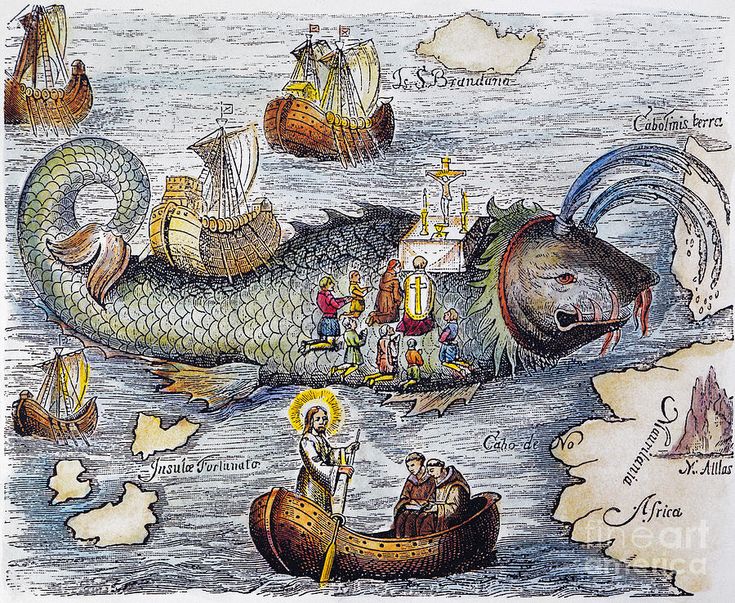
One of the most captivating stories from Brendan’s voyage is the Easter celebration on the back of a whale. According to the tale, Brendan and his crew, unable to find land during Easter, landed on a small island to hold Mass. As they concluded the service, the island began to move and they realized they had been on the back of a giant sea creature, presumably a whale.
The climax of St. Brendan’s voyage was the discovery of the Land of Promise. This land, as described in the Navigatio, was a paradise filled with lush vegetation, abundant flowers, and rich fruits. After spending forty days exploring this land, an angel appeared to Brendan and told him to return to Ireland. The angel informed Brendan that the Land of Promise would remain hidden until the end of time.
Following his epic voyage, St. Brendan returned to Ireland where he continued his ecclesiastical work. His accounts of the voyage spread far and wide, inspiring numerous manuscripts and adaptations.
You can also read the entire work about St. Brendan’s voyage HERE
So again, why is this story important, and what does it have to do with the Christian calendar. What we will immediately ask as modernists is, “did it really happen?” Of course we do, because if we cannot verify the historicity then it has no value to us. But in doing so, we miss out on how humanity has understood the purpose of the story. Not primarily for conveying how things actually happened, but conveying how things actually are; which is very much by definition what the parables of Christ are. This is something that both Tolkien and Lewis, likewise built their works around; some more on the nose like Lewis’ Narnia, but undeniably, the Lord of the Rings is doing the same thing in a different way.
When you read the Voyage of St. Brendan the Abbot, it is not just a seafaring adventure. The punctuated events of the story where the miraculous and amazing take place are during the different feasts and celebrations of the Church year. The celebration of the Pascha Vigil happens on the back of what modern people presume is a whale, and other key events happen on other feasts such as Pentecost.
In St. Brendan and his companions’ journey towards the beautiful and blessed land they were told of is very much like a parable of the Christian life. An early Celtic Christian version of Pilgrims Progress in its own right. Whether or not the journey happened is beside the point (as always these things have at minimum a core of truth is not the whole thing), but its importance comes in telling the reader how in the unknown and wild sailing through life that we all experience, there is something about coming to those places in commemoration of the work of Christ that allows the journey to continue.
So what does this mean for us Christians today? Well, we certainly cannot totally get rid of our secular national calendar; but it does mean maybe the calendar of our faith should supplant its supremacy in our lives. Why do we so often get so excited for Christmas? Well, because of the family, food and gifts. And yes, it is the celebration of the incarnation of Christ; but in reality it sometimes becomes secondary. Or what about Easter? Without doubt the MOST important date on the Christian calendar where His glorious resurrection took place, sealing His victory over sin and death on our behalf. We sometimes put it in second place to Christmas, while still talking about its importance.
But when the Christian calendar, the constant flow of the Gospel story through every year becomes the cornerstone of how we reckon our lives, something is different. Not at first. You might not fully see anything different the first few years of living this way (a place that I am still in). But what happens after maybe 4 or 5 years of centering your life around the Gospel is that you see how you are different as you continually encounter Christ on your way to that blessed land promised to the Saints.