by Joel V Webb | Oct 16, 2026 | Uncategorized
We are all subject to one kind of schedule or another. We all have something we are building our lives around, whether it is the secular national calendar where we immensely look forward to the 4th of July, Memorial Day, Thanksgiving and other holidays where most get time off, and see family. But this has not always been the way we have lived. In the past, the life of the Christian world was built around the story of the Gospel, likewise punctuated with celebrating the lives of Christians who demonstrated the love and character of Christ, and thus we now call them saints. I have written on the Christian calendar before, and there are many other better articles on this topic that I could ever write.
If you don’t know the general flow and movements of the calendar, go read one of those linked articles, and then come back.
Ok. So you know what the calendar is. Is. But why? What makes keeping and building our lives around the Christian calendar so important? Well, in order to tell you, let’s explore the story of St. Brendan the Navigator. From IrishHistory.com:
St. Brendan’s most famous contribution to Irish religious folklore is his legendary voyage across the Atlantic. According to “Navigatio Sancti Brendani Abbatis” (The Voyage of Saint Brendan the Abbot), Brendan was inspired by the story of St. Barinthus, who claimed to have discovered a land of abundance, which Brendan understood to be the “Promised Land of the Saints.”
Intrigued and driven by spiritual curiosity, Brendan decided to undertake a voyage to discover this Promised Land. He reportedly built a curragh, a type of Irish boat with a wooden frame covered in animal hides, and set sail with a group of fellow monks.
The tales of Brendan’s voyage, which reportedly lasted seven years, are filled with fantastical elements. His journey, as depicted in the Navigation, included encounters with enormous sea creatures, a floating crystal pillar, an island that turned out to be a sea monster, and a mysterious island inhabited by a hermit.
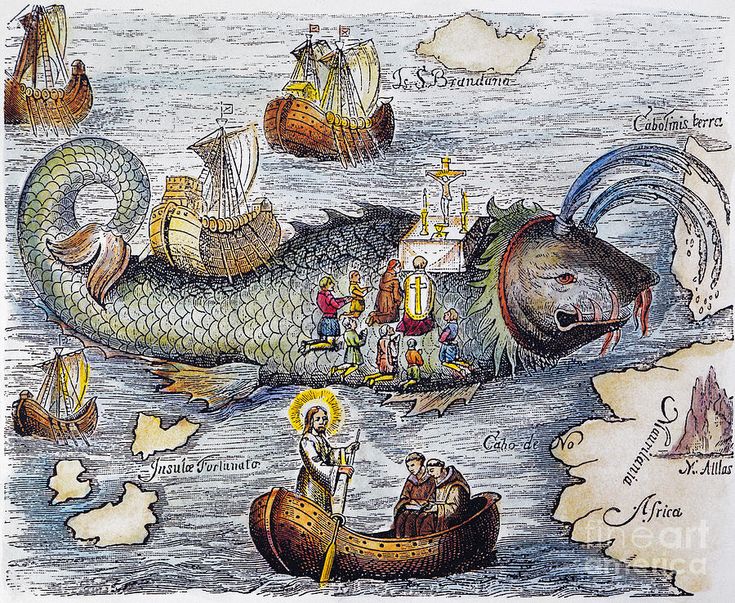
One of the most captivating stories from Brendan’s voyage is the Easter celebration on the back of a whale. According to the tale, Brendan and his crew, unable to find land during Easter, landed on a small island to hold Mass. As they concluded the service, the island began to move and they realized they had been on the back of a giant sea creature, presumably a whale.
The climax of St. Brendan’s voyage was the discovery of the Land of Promise. This land, as described in the Navigatio, was a paradise filled with lush vegetation, abundant flowers, and rich fruits. After spending forty days exploring this land, an angel appeared to Brendan and told him to return to Ireland. The angel informed Brendan that the Land of Promise would remain hidden until the end of time.
Following his epic voyage, St. Brendan returned to Ireland where he continued his ecclesiastical work. His accounts of the voyage spread far and wide, inspiring numerous manuscripts and adaptations.
You can also read the entire work about St. Brendan’s voyage HERE
So again, why is this story important, and what does it have to do with the Christian calendar. What we will immediately ask as modernists is, “did it really happen?” Of course we do, because if we cannot verify the historicity then it has no value to us. But in doing so, we miss out on how humanity has understood the purpose of the story. Not primarily for conveying how things actually happened, but conveying how things actually are; which is very much by definition what the parables of Christ are. This is something that both Tolkien and Lewis, likewise built their works around; some more on the nose like Lewis’ Narnia, but undeniably, the Lord of the Rings is doing the same thing in a different way.
When you read the Voyage of St. Brendan the Abbot, it is not just a seafaring adventure. The punctuated events of the story where the miraculous and amazing take place are during the different feasts and celebrations of the Church year. The celebration of the Pascha Vigil happens on the back of what modern people presume is a whale, and other key events happen on other feasts such as Pentecost.
In St. Brendan and his companions’ journey towards the beautiful and blessed land they were told of is very much like a parable of the Christian life. An early Celtic Christian version of Pilgrims Progress in its own right. Whether or not the journey happened is beside the point (as always these things have at minimum a core of truth is not the whole thing), but its importance comes in telling the reader how in the unknown and wild sailing through life that we all experience, there is something about coming to those places in commemoration of the work of Christ that allows the journey to continue.
So what does this mean for us Christians today? Well, we certainly cannot totally get rid of our secular national calendar; but it does mean maybe the calendar of our faith should supplant its supremacy in our lives. Why do we so often get so excited for Christmas? Well, because of the family, food and gifts. And yes, it is the celebration of the incarnation of Christ; but in reality it sometimes becomes secondary. Or what about Easter? Without doubt the MOST important date on the Christian calendar where His glorious resurrection took place, sealing His victory over sin and death on our behalf. We sometimes put it in second place to Christmas, while still talking about its importance.
But when the Christian calendar, the constant flow of the Gospel story through every year becomes the cornerstone of how we reckon our lives, something is different. Not at first. You might not fully see anything different the first few years of living this way (a place that I am still in). But what happens after maybe 4 or 5 years of centering your life around the Gospel is that you see how you are different as you continually encounter Christ on your way to that blessed land promised to the Saints.

by Joel V Webb | Oct 12, 2026 | Uncategorized
There’s a joke of a conversation between a husband and wife talking about where they want to go for their date night. The husband promises his wife, after telling her to get all gussied up that it will be an expensive place. And they go to a gas station.
Outside of a joke about the universal understanding that the price of gas is always too high, we also tacitly grasp the reality that a date at a gas station may have its issues. I am not saying that there are no situations in which a gas station date isn’t unique, necessary, or is something that makes a memorable time together when you think back on it. What I am saying is that beyond moving beyond initial objections you begin to realize that questionable sushi, slushies, corn dogs and dry pizza that all tastes of the overly processed ingredients in it is not what one thinks of when you talk about going on a date.
When it comes to the worship of the Church, especially surrounding the Sacraments, there has been a tendency, especially since COVID to hold up pragmatism and simplicity as the highest objective. This is demonstrated most profoundly and sadly in the Evangelical realm surrounding the celebration of the Lord’s Supper.
I grew up being used to taking one of the little plastic cups from the tray, and a piece of broken matza bread whenever we celebrated communion (once a month at the church my dad pastored). But something has dramatically changed in the last five plus years. While the little prepackaged communion cups had already existed, COVID threw them to center stage as the best option for churches to celebrate communion with the lowest possible chance of passing on the plague.
While the momentary reasons for its use have passed, yet the use of these little cups has persisted. It’s easy to buy a box of 1000 of them, pass them out, or set them in a basket to do communion and then throw them out. No prep time, lower chance of spills, and the ease of them. But we never seem to ask what we lose when we go this route?
There are multiple things I am thinking of that are lost when we celebrate the memorial of our redemption in this way, but what I want to reflect on here is the fact of beauty. This reality of beauty is one of the last asked questions in the modern Evangelical space, and I am increasingly saddened by it. The church use to be known for reflecting the beauty of God in creation through our construction and ceremony. But in the last several generations especially that has been discarded.
When we replaced precious metal, wood or pottery chalices filled with the fruit of the vine and plates with hosts or bread to mini-disposable communion cups with highly processed elements, it visibly screams that matter doesn’t matter. There is something wonderful about a community gathering around a single table where the words of St. Paul are enacted when he wrote “Because there is one loaf, we, who are many, are one body, for we all share the one loaf.” (1 Cor. 10:17) Rather, in our Modern Western ideal, we celebrate together but individually separated by our own, fast-food packaged elements.
Of course there is more that could be said about this, and I certainly did not contextualize everything to the extent some would want; but I think my point is clear. Individual, prepackaged communion cups are by no means sinful. But they do reflect a tendency in modern Evangelicalism to trend towards the disposable and easy at the loss of other things that the Church has valued since its founding.

by Joel V Webb | Feb 5, 2026 | Uncategorized
One of the things I often ask my wife after a Sunday service is, “how do you feel it went?” Seems like a normal question, right? We want to know how things went, if they were good, or if things bombed. But in recent months I have been working by God’s grace to shift my focus from asking about how things felt, to if they were faithful.
I think this is one of the biggest traps of the modern evangelical world. The question we are always seeking to answer is, “how do we feel about this?” And while our emotions are from God, and are important, I think we have put too much focus on whether or not something felt right, rather than focusing if things were faithful, and that we encountered God. It’s like we’ve built our spiritual lives around chasing that next emotional high, the kind that comes from a perfectly timed light show or a song that hits just right in the chorus. We walk out of church buzzing, convinced we’ve had a profound encounter with the divine because our hearts raced and tears flowed. But what happens the next week when the music doesn’t land the same way, or the preacher’s message feels a bit flat? Suddenly, doubt creeps in. Did God show up? Was it real? This cycle leaves us fragile, tethered to our moods rather than to the unchanging faithfulness of Christ Himself.
The Psalms model this beautifully for us. David cries out in the rawest emotion, from despair to ecstasy, but he always circles back to God’s steadfast word and promises. “Your word is a lamp to my feet and a light to my path,” he declares in Psalm 119:105. That’s not about feeling enlightened; it’s about faithful obedience in the dark. This emotionalism didn’t come from nowhere. It traces back through revivalist traditions, where manipulating crowds for decisions became the measure of success. Charles Finney and his “new measures” in the 19th century turned meetings into high-stakes emotional theaters, complete with anxious benches and public professions designed to wring out responses. It worked for a season, filling pews and sparking movements, but it planted seeds of shallowness. Today, we see it in worship sets engineered like rock concerts, sermons crafted for viral soundbites, and metrics obsessed with attendance bumps or altar call counts. Emotions become the goal, truth the casualty. Jonathan Edwards saw this danger early on, warning in his treatise on religious affections that not every tear or thrill proves the Spirit’s work. True godliness flows from a renewed mind delighting in God’s glory, not from stirred sentiments that mimic conviction.
Contrast that with the ordinary means God has given His church: the faithful preaching of the Word and the right administration of the sacraments. These aren’t flashy tools for excitement; they are the steady channels through which Christ pours out grace, week after week, whether we feel it or not. Picture the early church in Acts 2:42: “They devoted themselves to the apostles’ teaching and the fellowship, to the breaking of bread and the prayers.” No mention of emotional metrics there, just persistence in Word, sacrament, and prayer. Paul hammers this home in 1 Corinthians 11, rebuking the Corinthians not for lack of feeling but for profaning the Lord’s Supper through division and selfishness. The Table isn’t valid because it moves us; it’s powerful because Christ is truly present, feeding our souls with His body and blood. The reformers like Calvin echoed this, insisting that God binds Himself to these visible signs, making them efficacious for faith not by our emotional response but by His faithful promise. Faith comes by hearing the Word (Romans 10:17), and the sacraments confirm it tangibly, sustaining us in dry seasons when emotions fail.
Theologically, this anchors us in God’s covenantal fidelity. Hebrews 10:23 urges us to “hold fast the confession of our hope without wavering, for he who promised is faithful.” Our perseverance isn’t self-generated enthusiasm but participation in Christ’s own faithfulness, mediated through preaching that declares His finished work and sacraments that apply it to us personally. Baptism marks our dying and rising with Him once for all (Romans 6:3-4), a seal that no mood swing can undo. The Eucharist proclaims His death until He comes (1 Corinthians 11:26), nourishing us with grace that outlasts every high or low. This is paleo-orthodox wisdom, recovered from the church fathers who saw Word and Table as the rhythm of divine life in the body of Christ. Augustine called sacraments “visible words,” precisely because they convey truth beyond what feelings can grasp or guarantee.
Emotionally driven worship, by contrast, risks idolatry. It elevates experience over revelation, making the Spirit’s work dependent on human techniques rather than sovereign grace. John 4:24 commands worship “in spirit and truth,” where truth proclaimed and enacted precedes and provokes any genuine affection. When churches prioritize “what moves us,” they breed consumerism, where believers shop for services that deliver dopamine hits, abandoning the ordinary when it grows mundane. The result is fragility: shallow roots that wither in persecution or trial, as Jesus warned of the rocky soil in Mark 4:16-17. True spiritual vitality grows through steady feeding on Christ in His appointed ways, producing fruit that endures by the Spirit’s hidden labor.
In terms of praxis, this shift demands rigorous discipline. Begin with the pulpit: Preach the whole counsel of God, letting Scripture dictate the content rather than chasing relevance through felt needs or cultural hooks. Let exegesis drive application, trusting the Word itself to convict, comfort, and convert. For sacraments, recover their frequency and centrality. Move toward weekly Eucharist not as an add-on but as the climax of every Lord’s Day gathering, offered to all baptized believers without barriers of performance or worthiness. Administer baptism with catechetical preparation, teaching it as the foundation of Christian identity that no emotion can confer or revoke. Structure services around these means: Call to worship from Psalms, confession and assurance rooted in gospel promises, creed for shared belief, sermon for grounding and growth, Table for nourishment, and sending with benediction. Soak every element in prayer, drawing from the church’s historic offices to guard against novelty.
Evaluate Sundays by faithfulness, not feedback. Ask: Was the Word handled accurately, free from gimmicks or personal anecdotes that overshadow Christ? Were sacraments administered reverently, pointing beyond themselves to the Lord? Did the liturgy form us as a covenant people, confessing sin together, receiving grace together, feasting together? Train leaders and congregations alike in this metric through teaching and example. Small groups can reinforce it by studying Scripture exposition, sacramental theology, and the lives of saints who persevered without spectacle. Youth ministry shifts from entertainment to catechism and Table, equipping the next generation to value fidelity over flash. Even outreach flows from this: Evangelism proclaims the same Word preached inside, inviting sinners to baptism and Supper as entry into Christ’s body.
This praxis isn’t anti-emotion; it’s pro-truth. Holy affections, as Edwards described them, arise naturally when we behold God’s glory in the face of Christ through faithful means. Joy erupts at the Table’s foretaste of the kingdom. Awe fills preaching that unveils the cross’s depths. Love binds the fellowship around shared bread and cup. But these are fruits of the Spirit, not engineered results. When faithfulness governs, God surprises us: Quiet services become profound, dry seasons yield growth, and unity deepens amid diversity. Churches marked by this rhythm resist cultural drift, standing as outposts of the kingdom where God’s faithfulness holds His people steady.
Historically, this recovers the best of our traditions. Wesley, though his ministry is known for revival, urged constant communion and saw sacraments as “means of grace” where God works beyond feeling. The Free Methodist heritage, with its love feasts and emphasis on holiness, points toward a sacramental renewal that integrates evangelical zeal with ordered worship. Broader catholic practice, from Anglican formularies to Reformed confessions, affirms Word and sacrament as sufficient for the church’s life. In our time of hype and hurry, this theology and praxis offer rescue: a return to what God commands, because He is faithful to save and sustain through it.
The call is clear and urgent. Let us measure church life by alignment with divine appointment, not human applause. Prioritize preaching that thunders gospel truth. Elevate sacraments as the pulse of gathered worship. Persevere in these means through every season, confident that Christ builds His church upon them. Emotions will ebb and flow, but His word endures forever (Isaiah 40:8). In faithfulness over feeling, we find the treasure: a people held by God’s steady hand, encountering Him truly every Lord’s Day.

by Joel V Webb | Jan 29, 2026 | Uncategorized
The phrase “life giving church” gets thrown around a lot these days. It’s used in prayers, fills mission statements, church websites, and social media posts that promise energy, joy, and transformation. It sounds good on the surface. Who wouldn’t want to be part of something described as life giving? Yet when I hear it used so casually and so often, I grow skeptical. What exactly do people mean by it? And why does it so frequently carry the whiff of criticism aimed at churches that don’t fit a particular mold?
For many, the phrase describes a certain atmosphere: lively music, passionate preaching, a palpable sense of excitement in the room. It feels alive, modern, relevant. I’ve sat in those spaces and felt the draw. But let’s be honest. The way “life giving church” gets deployed often functions as coded criticism of historic expressions of the faith. Quieter, more liturgical congregations, with their ordered prayers, ancient creeds, and reverence for sacrament, get quietly dismissed as lifeless or outdated. The implication hangs in the air: if your worship doesn’t pulse with contemporary energy, if it doesn’t chase emotional highs, then it must not be giving life. Is that fair? Or is it just a subtle way to elevate one style while sidelining centuries of faithful Christian practice?
That skepticism runs deep for me. Life in the biblical sense cannot be reduced to mood, tempo, or emotional experience. If “life giving church” means anything substantial, it must be rooted in something deeper and more enduring than surface vitality. Otherwise, it risks becoming a slogan that divides rather than builds up the body of Christ.
Over the last few decades, the phrase has morphed into a kind of brand identity. Churches wield it like businesses tout “fresh” or “authentic,” signaling a cultural style over theological depth. The assumption seems to be that the church’s job is to manufacture an atmosphere of aliveness, as if the Holy Spirit’s work depends on our production values. But does it? There is a place for joy and warmth in worship, to be sure. God wired us as emotional creatures, and joy is a fruit of the Spirit. Yet the early church never marketed itself as life giving because of its energy or entertainment. It simply abided in communion with the risen Christ, letting His life flow through ordinary means. When we make liveliness our yardstick, we exchange the living water of the gospel for decorative fountains, pretty but ultimately shallow.
The Book of Acts offers the clearest scriptural portrait of life together in Christ. Luke records, “They devoted themselves to the apostles’ teaching and the fellowship, to the breaking of bread and the prayers.” There’s the pattern, plain and unadorned. They were alive because they were devoted. Life wasn’t manufactured; it flowed from nearness to the living Christ through four unchanging practices.
They clung to teaching, the apostles’ doctrine handed down from Jesus Himself. That Word was their anchor, not an optional add-on. Wherever Christ’s truth is faithfully proclaimed and received, the breath of life stirs. They practiced fellowship, true koinonia, where believers bore burdens, forgave freely, and shared generously. Life grows when it is poured out for others. They gathered at the breaking of bread, the Eucharistic feast where Christ offers Himself as bread for the world. In that sacred mystery, the church finds its pulse, feeding on the One who conquered death. And they prayed without ceasing, their lives a constant turning toward God’s presence and will.
What strikes me most in this picture? The absence of any mention of style, mood, or method. No guitars or fog machines, no emphasis on feeling “filled.” The church in Acts was life giving precisely because it fixed its gaze on Christ, not because it nailed the perfect vibe. To question that is to question whether we’ve learned anything from the first Christians.
Jesus Himself cuts through the confusion: “I am the way, the truth, and the life.” Life isn’t a sensation; it’s a Person. Paul unpacks this in Romans: “We have been united with Him in a death like His… united with Him in a resurrection like His.” The church’s vitality is participation in Christ’s risen life, mediated through Word and sacrament. Baptism buries us with Him and raises us anew. The Eucharist feeds us with that same life, week by week. This isn’t fleeting emotion but deepening communion. A life giving church makes Christ present: His Word thundered or whispered, His table spread humbly, His Spirit moving among the gathered faithful.
Such a church might look traditional or contemporary, urban or rural, high church or low. Skepticism of the phrase “life giving” arises precisely because it so often polices those boundaries, casting shade on historic forms as if they can’t possibly pulse with divine life. But they can, and they do, when rooted in the same devotions.
We needn’t scrap the phrase altogether. It holds truth worth reclaiming, but only if measured by Scripture, not trends. A life giving church centers the gospel, forgives sinners, welcomes strangers as family. It feeds the hungry in body and soul, weaves prayer and hospitality into daily rhythm. Its life shows in love’s generosity, not song’s volume. This frees us profoundly. Pastors needn’t stage excitement. Congregations needn’t mimic the popular. Life is gifted in Christ; we simply abide and receive.
Recall Christ’s post-resurrection moment with His disciples: He breathed on them, saying, “Receive the Holy Spirit.” That breath, divine life shared with dust, animates us still. A life giving church carries that breath outward, becoming springs of living water through Word, sacrament, fellowship. It’s presence, not performance, echoing from Jerusalem’s upper room to today’s pews and folding chairs.
The church isn’t called to sell liveliness but to live it faithfully, devoted to Acts’ four pillars until the world glimpses Christ dwelling among us. That’s a truly life giving church: not styled by preference, but saved by a Savior; rooted in Word and Sacrament, sustained by prayer, bound by love. It may not always thrill, but it endures. And in that quiet endurance, it gives life to the world.

by Joel V Webb | Jan 26, 2026 | Uncategorized
According to the old liturgical calendar, this last Sunday (Jan. 25, 2026) was the last Sunday of Epiphany. That seems strange, because in modern lectionary and liturgical calendars, we still have three more Sundays until Ash Wednesday, and the official start of Lent. But in the old calendar, like the one we use at my church (the 1662 Lectionary with OT additions from the Canadian Prayer Book Society), we are getting ready to enter into what has been known as the pre-Lent season, with three strangely titled Sunday of; Septuagesima, Sexagesima and Quinquagesima Sunday’s. The three names of these Sunday’s come from the Latin origins, stating how many Sunday’s we are away from Easter. Going 70, 60 & 50 days.
These three Sunday’s provide a unique opportunity to ease into the penitential nature of Lent from the joys of Christmas, and the season of Epiphany where the power and nature of Christ are revealed.
Known collectively as Gesimatide (from the old German for these Sundays), this violet-clad interlude, roughly three weeks long, shifts the church’s tone without the full rigor of Lenten fasting. Gloria and Alleluia vanish from the Mass or Mattins, Tract replaces the Alleluia, and a somber expectancy builds, much like church bells tolling faintly before the Lenten knell. Retaining these in traditional Anglican, continuing Anglican, and some Lutheran rites honors a practice traceable to St. Gregory the Great around 600 AD, bridging Epiphany’s manifestation to Quadragesima’s (Lent’s) forty days.
Opening this trio about 63 days before Easter (not precisely 70, but evocatively so, recalling Israel’s 70-year exile), Septuagesima calls us to spiritual toil. The Gospel’s parable of the vineyard laborers (Matt 20:1-16) shatters merit-based thinking: latecomers receive the same denarius as early risers, revealing God’s prodigal grace. Paired with St. Paul’s runner straining for an incorruptible crown (1 Cor 9:24-27), it urges disciplined training, temperance in all things, for the heavenly prize. Adam’s curse of sweatful labor echoes here, yet Christ’s generosity redeems it.
Roughly 56 days out, Sexagesima turns to providence amid trial. Noah’s ark (Gen 1-8 in some uses) and the sower’s parable (Luke 8:4-15) dominate: seeds fall on varied soils, but God’s Word endures floods and thorns. Paul recounts his thorn in the flesh (2 Cor 11-12), modeling perseverance. It’s a Sunday for battered faith, joy in weakness, trusting the Seed that multiplies despite rocky paths.
At ~49 days (echoing Jubilee’s 50), Quinquagesima crowns the season with love’s supremacy (1 Cor 13). The blind man’s sight restored (Luke 18:31-43) mirrors our Lenten unveiling, as Christ foretells His Passion. Abraham’s faith may appear in OT lessons, but charity binds all: without it, even prophetic gifts clang empty. Shrove Tuesday confessions often follow, purging the soul for Ash Wednesday.
This pre-Lent rhythm, far from archaic, offers graduated resolve, like an athlete’s warm-up or a laborer’s dawn hiring. In our rushed age, it invites deliberate turning toward Easter’s victory, one numbered Sunday at a time. But its deeper importance lies in reclaiming a lost art of spiritual preparation, countering the modern temptation to plunge headlong into disciplines without reflection.
Consider our fractured world: instant gratification erodes patience, self-promotion mocks humility, and superficial faith withers under trial. Gesimatide counters this with measured mercy. Septuagesima dismantles pride in our “early arrival,” teaching that God’s kingdom values grace over merit, vital for a culture obsessed with achievement. Sexagesima steels us against despair, reminding Noah-like believers that God’s ark preserves through storms, and His Word, sown generously, yields harvest in unlikely soil. Quinquagesima then clothes these truths in charity, the “greatest” virtue that outlasts all, preparing hearts not just to endure Lent but to love through it.
Historically, this season echoed Eastern asceticism, where Lent’s intensity demanded forewarning, and Western monks buried the Alleluia at Septuagesima’s close in symbolic funerals. Today, amid secular calendars that rush from holiday to holiday, it restores sacred time’s cadence. For pastors and parishioners alike, it fosters communal momentum.
In Free Methodist or Anglican contexts like ours, embracing Gesimatide bridges confessional depth with evangelical zeal. It humanizes Lent, making repentance feel like a gracious invitation rather than a grim duty. These Sundays whisper: Run well, endure faithfully, love supremely—not for corruptible crowns, but for the imperishable joy of Resurrection. Let us, then, heed their numbered call, stepping from Epiphany’s light into Lent’s refining shadow, hearts attuned to Easter’s dawn.
by Joel V Webb | Jan 17, 2026 | Uncategorized
If it hasn’t become clear, one of my favorite topics in theology and Christian practice are the Sacraments, particularly communion (Lord’s Supper, Eucharist etc…). The enduring and central nature of it’s celebration has been the core of Christian worship since the time of Acts, as we know the early church “They devoted themselves to the apostles’ teaching and to fellowship, to the breaking of bread and to prayer” (Acts 2:42 NIV).
In past posts and articles I have spoken of some of the reasons why coming around the table has become infrequent in some parts of the modern Church. Part of the disconnect that I think there is centers around a question that many of us take for granted. What is worship? For many, the word worship evokes the idea of music and singing, and I think that’s what most of us think. When we speak of a worship service, we also include prayer and hearing/sharing from the Word. But we have to ask, is that the extent of worship?
Before we came come to a contemporary assertion or application we have to ask the question, what did worship look like in the Old Testament? We certainly see Psalms and songs, and other things that we often associate as worship. Yet, the summit and pinnacle of what we see as worship of God’s chosen people is sacrifice. There is never worship to the one and true God that does not include the offering and giving of something.
Now as a note, the sacrifices in and of themselves were not what ultimately pleased God. The prophets are filled with chapters speaking about how the sacrifices and religious practices of Israel are detestable to God because of their disobedience to His law, and so all worship, whether sacrifice, song or anything else must always be paired with a broken and contrite heart as the psalmist writes in Psalm 51.
Now as a note, the sacrifices in and of themselves were not what ultimately pleased God. The prophets are filled with chapters speaking about how the sacrifices and religious practices of Israel are detestable to God because of their disobedience to His law, and so all worship, whether sacrifice, song or anything else must always be paired with a broken and contrite heart as the psalmist writes in Psalm 51.
If worship in the old covenant reached its height in the offering of sacrifice, then the coming of Christ brings this reality to its perfect completion. In Jesus, we see both priest and victim, the one who offers and the one who is offered. The cross becomes the once-for-all act of worship, the great oblation in which sin is finally dealt with and humanity is brought into reconciliation with God. The letter to the Hebrews proclaims this with clarity: where the blood of bulls and goats could never take away sin, Christ’s self-offering has done so forever.
And yet, that singular sacrifice did not end worship, it transformed it. The Church, in every generation, participates in that one sacrifice through what Jesus commanded us to do: “Do this in remembrance of me.” When we gather at the Table, we do not offer a new sacrifice, but rather enter into the one eternal sacrifice of Christ made present by the Spirit. This is why the Eucharist is not just a symbol or a memorial meal; it is participation. It is communion, not only with one another, but with the very life of God through the risen Christ.
This is what makes the Table the beating heart of Christian worship. Every prayer, every reading of Scripture, every hymn, and every act of fellowship ultimately orients us here, to the place where heaven and earth meet, where Christ is both host and feast. Without the Table, our worship easily drifts into abstraction or emotional expression alone. But at the Table, we are grounded again in God’s concrete grace, in bread broken and wine poured out.
If worship is the offering of ourselves to God, then here is where that offering finds its true pattern. We come forward not merely to receive, but to be made into an offering, “living sacrifices,” as Paul says in Romans 12. The Table is where we learn what it means to worship in spirit and in truth: not only with our lips, but with our lives.
If we recover this understanding of worship, that it centers not on what we bring, but on what Christ has already brought before the Father, then the call to return to the Table takes on fresh urgency. Regular communion is not just about returning to a historic pattern; it’s about rediscovering who we are as the Church, the Body of Christ made one in Him.
The Table is not the privilege of one denomination or cultural expression, but the inheritance of all who are joined to Christ through faith and baptism. In a world fractured by ideology, nationalism, and individualism, the Eucharist becomes a counter-sign, a visible witness to the unity that already exists in the risen Lord. Around this Table, there is no hierarchy of worth, no division of class or nation. There is simply grace received together.
When we kneel or stand side by side to receive from the one loaf and one cup, we are participating in something that heals the fractures of both Church and society. The early Christians knew this: the meal that bound them to Christ also bound them to one another. It was their act of resistance against the world’s ways of dividing and excluding. Perhaps that is why, in our fragmented and polarized age, the Spirit is stirring the Church across traditions to return again to frequent communion, not as ritual nostalgia, but as a prophetic act of unity and hope.
For those of us in the Free Methodist and broader Wesleyan traditions, this means seeing the Table not as an optional add-on, but as central to our life together. Each time we share in the bread and cup, we are declaring that Christ’s sacrifice is enough, that His kingdom is breaking in, and that we belong not only to Him, but to one another. If we could begin to live as people shaped by this Table, forgiving as we have been forgiven, giving as we have received, then the unity we proclaim would become visible in a world desperate for reconciliation.
In the end, “Why the Table?” Because this is where the Church becomes truly herself. This is where the world catches a glimpse of what it longs for: a community reconciled by grace, gathered not by preference or power, but by the love that was broken and poured out for us all.