Book Review – Against the Machine
Every once in a while you encounter a book that makes a deep and lasting impact. I remember when I read The Unseen Realm by the late Michael Heiser and my eyes were open to seeing the supernatural thread that was weaved all throughout Scripture. Taking seriously the cultural and historical context of the Old Testament, and its inherent influence on the New Testament provided a massive shift in some of my understanding of Scripture.
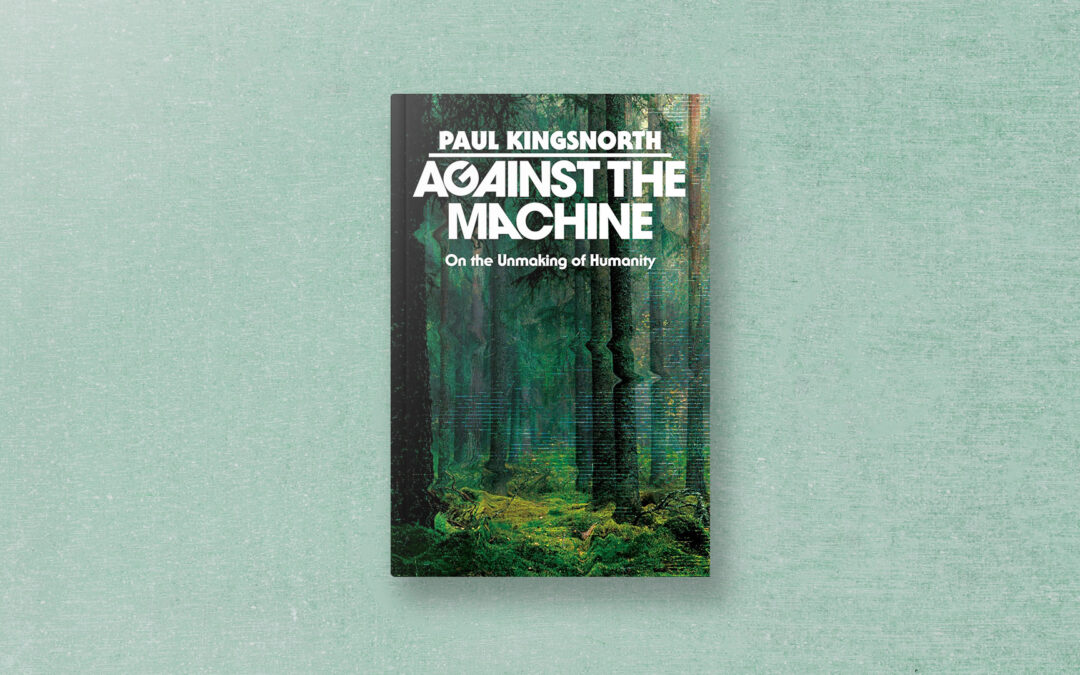
In a similar vein that happened once I finished the first chapter of Against the Machine by Paul Kingsnorth. Published in 2025, I first encountered this book when it was referenced during a plenary session at a conference I was attending. And then, a few months later, one of my Facebook friends posted a picture of the beginnings of one of the chapters, and I knew it needed to be on my reading list.
Kingsnorth opens, naming the reality that we know something is wrong in the West. As he states in his introduction, “I was sure of something else too: that the political and cultural upheavals which continue to roil the West have historical, technological and ultimately spiritual roots.” And it is this theme that he carries through the entire work with a scary amount of accuracy, tracking and tracing why we are where we are today.
As a personal note, this book came at a providential time. A few years ago when I read St. Augustine’s City of God, I felt a huge sense of affinity with what he was writing about. The seemingly timeless Roman Empire in a state of rapid decline and collapse, and having to ask the hard questions about the why. We are living in a similarly transitional time in history. As Kingsnorth points to, “The West” began in earnest around 1000 AD, with it;s apex in the high Medieval period, and then since the 15th and 16th centuries, it has been a slow march into the lightspeed acceleration of our era of advancing technology.
Kingsnorth is honest, there is no perfect society. The West has many skeletons in it;’s closet, and hanging from the battlements. And despite the narrative of critical theorists, every culture and society in the history of humanity does. He is not shy about addressing these issues, and in doing so provides an even playing field to address why we are where we are.
The feeling that is addressed most commonly in the book is the feeling (that I myself feel at times) is of not being rooted. Sure, I have a hometown, place I live, I know a bit about my genealogy and yet it feels like something is missing. This was highlighted even more when I lived in Cameroon for a year. Spending time in various villages, and with people who were connected to their families, and not just to people but to the land. Yet, in the modern west, we are not connected. Land is just where we are, and there is nothing special about it. And that is part of the problem. Not that we worship or idolize the land, but we are not connected to it, And it is this feeling Kingsnorth not just describes, but diagnoses.
Tracing the history of the West through to our day into what can be labelled The Faustian Age, where we are striving for knowledge, power, and self-realization, often associated with the themes of ambition and the pursuit of the infinite. This perfectly describes our time. Totally apprehended by materialism, we seek to not just know, but control, extract and break all limits. And, this is a culture that is dead. While the West began as Christendom, we have taken Christ from His throne, and eventually that vacancy will be filled. But until then, we will continue to experience the death throws of a culture in unrooted freefall.
Everything in our age is about limitless growth, progress, secularism, and ultimately a deep disenchantment that all of us feel when we think about it for more than am inute. It is this way that Kingsnorth thus defines “The Machine”
This, then, is the Machine. It is not simply the sum total of various individual technologies we have cleverly managed to rustle up—cars, laptops, robot mowers and the rest. In fact, such ‘technics’, as Mumford calls them, are the product of the Machine, not its essence. The Machine is, rather, a tendency within us, made concrete by power and circumstance, which coalesces in a huge agglomeration of power, control and ambition.
Kingsnorth then spends most of the book detailing the many different ways that the Machine was developed and grown at a steady and increasing pace for it’s own existence. Culture, the thing that once served people in the role of commonality of those around us has turned into the thing that actually uses humanity as its fuel to keep it going, in it;s own version of The Matrix.
It is this question of culture that becomes the pivotal core of the discussion of not just why we are here, but also what we need to do in seeking to leave or be against he machine. He concisely lays out culture as the summation of the 4 P’s. People, Place, Prayers, and Past:
Past. Where a culture comes from, its history and ancestry.
People. Who a culture is. A sense of being ‘a people’.
Place. Where a culture is. Nature in its local and particular manifestation.
Prayer. Where a culture is going. Its religious tradition, which relates it to God or the gods.
Similarly, Kingsnorth identifies the core realities of the Machine in the four S’ which represent not just “the culture of the Machine” but really the inversion culture where things are not defined by what they are, but rather by what they are not:
Science. Where we come from. Science can offer us a non-mythic version of this story, and assert a claim as to the true (i.e. measurable) nature of reality.
The Self. Who we are. The highest good is to serve the self and ensure its longevity.
Sex. What we do. Both the highest means of sacral pleasure and, through public expressions of ‘sexuality’, an affirmation of individual identity.
The Screen. Where we are going. The screen is both our main source of distraction from reality and the interface by which we are directed into the coming post-human reality of the Machine.
These four notions are the “ideology of the Machine” if one can be defined. As you can likely tell, these aspects are very relevant to what we see going on in the world around us. The insanity and lack of logic in the secular sphere, the inability to articulate even obviously true things, and our inability to know what is even going on.
So what about politics? If you are conservative or liberal/progressive you might be mistaken that Kingsnorth is writing this in support of your ideology. He’s not. He is very clear at numerous points that both sides of the political debates in our day and age are simply different parts representing the machine. Conservatism is simply just looking to change less quickly that the other side is wanting things to.The entire political spectrum as we know it is a product of the machine, and is in the end interested in its survival.
Now what about the Church? Well, if we are honest we see how the Machine has influenced and impacted the Church in the West, especially contemporary evangelicalism. Over the last few years the murmurings of conversions of young men, and those in Gen Z & A have started to grow louder. People I know across the board in traditional expressions of Chrisitanity, especially Catholicism, Orthodoxy and Anglicanism in particular are seeing this growing interest, and real growth. Why? Because outside of the necessity for authenticity in an age of advertising, the modern Protestant Church has wholly given in to the methods of the Machine.
How do we plant churches? We set everything up like the launch of a new IPO, gathering resources to then make the biggest bang possible. How do we prepare the next generations of clergy and layleaders in the Church? Give them fundamentals of leadership and management skills that will also serve them well in the secular business world. What about our “worship” and Sunday gatherings? We might have sound theology and a desire to honor God, but change a few words and you don’t have anything that is distinguishable from a concert with a motivational talk in it about how “God can do something for you”.
Our ways of thinking and doing are almost wholly the ways of the Machine, just dressed up in Church language. Do we need something to change? Launch and initiative to get people excited. Something not working as we think it should, restructure and reformat because doing something might help things change how we want them. This part might just sound like complaining or ranting, but there is a point to it which I will touch on later.
So what are we to do with this? Is everything just a drab and depressing situation that is hopeless? With Kingsnorth’s wide usage of seemingly prophetic philosophers and poets (especially the recently passed Wendell Berry), and especially for us as Christians, what does all of this mean?
First, none of this should be a surprise. Just as I referenced St. Augustine and the fall of Rome earlier, we should not think that all is lost. Cultures have risen and fallen throughout history, and who are we to think that we are any different? Yes, while the West spread the word of the Gospel across the earth, the West has also gotten in the way of the Gospel actually doing what it was supposed to, seating Christ as the true and ultimate King over all things. The West has become obsessed with her own grandeur, economic advancement and comfort, all things that detract from the reality that Christ’s Kingdom is not of this world.
The West is in the process of falling. It may outlast my lifetime, but that would be a miracle. Something over the next 50-100 years will take its place. But just as St. Augustine was sure, the Church will continue and the Gospel will be preached, and Christ’s Kingdom will expand, regardless of where the locus of power and culture is.
Secondly, in our world that is even more interconnected and global, we need to think smaller. This does not mean we stop world missions, but for our individual lives (our circles of relationships), our families and our churches we seem to be obsessed with the biggest reach possible. Rather, we need to ground ourselves closer to home. Be who we are, redeemed by Christ. One of the joking quips often used by other cultures is that “White people don’t really have culture”, and in the contemporary sense that’s not totally wrong. Those who are Caucasian and from Western Europe, especially those in North America have lost our distinctiveness. We need to become more rooted and grounded in that. Not for the purpose of tribalism, but so that we can then relate to others at our common points.
One of the defining characteristics of the Machine as Kingsnorth writes is that it steam rolls other cultures to become homogenized within it. From the Black Ships of Perry opening trade in Japan, to the global internet culture that is consuming our cultures into a single blob of humanity; we lose who we actually are. Again, the purpose of this call is to not become more suspicious of those different than us, but how can we truly appreciate others if we don’t even know who we are?
Third, as the Church we need to wholly reclaim what it means to be in and not of. We are all products of our times, and we can never escape that. But we also can be adapted by our times, which can compromise our witness of being of a different Kingdom. The West as it falls is a challenging time. And we might not even be sure its happening, but it is. What that means is that using the means that have brought us to where we are, is maybe not the way we are to be the Church. This isn’t wholly about aesthetics and worship style…but at the same time it is. The Western Church is dominated by the cult of individualism, and until we repent and cast that idol out, we will be stuck spinning our wheels in the mud of the age going nowhere.
I truly believe the Church is indefectable. While she errs, she will in the end accomplish the goal that Christ established her for. And that means that we at times need to course correct from where we have gone off.
The idea of the Machine has been in recent years somewhat grasped in the language of “Empire”. And while that language can be helpful, the idea of the Machine helps articulate the even deeper issues at play. The gods of old have disguised themselves in our modern era (note back to Heiser), and more often than not we are simply Modernists who go to Church. Our minds are shaped and we operate under the premises set out by the Machine (the 4 S’s). What could be the fruit of that?
A fantastic companion book to this would be The Desecration of Man by Carl Trueman, that David Watson, the President of Asbury Theological Seminary wrote a wonderful review of. Trueman and Kingsnorth touch on many of the same ideas, they give complementary language and verbiage to what we are living in now. And while Kingsnorth is a Christian (he converted to Eastern Orthodoxy in 2020), Trueman’s work is significantly more theologically directed as it is philosophical.
So we then, as Christians are ultimately called to be against the Machine. Just as the powers and principalities, and the “spirit of the air” as spoken of by St. Paul in the Apostolic Era, likewise we have “the Machine” as the all-encompassing spirit of the age that seeks to oppose Christ and His Bride. Seeking to hollow us out, distract us from reality and turn us from the beauty that is the creation He created us to inhabit. Resistance to the Machine looks like truly living out The Sermon on the Mount. It looks like rejecting to different degrees the things the Machine desires to make dogma.
There are so many other threads in this work that I did not even touch that are also vitally important and help flesh out the entire picture. But I focused on what I could and what seemed important as I am writing this. So rather, let this wet your appetite, and go pickup the book and read it for yourself.
Kingsnorth ends his work not by giving a tidy list of actionable items necessarily. His work, being more philosophical, seeks to set the stage for us to seek how Christ is calling us into the world of the Machine to shine His light of new life. I will end this review with the last few paragraphs of his book because I cannot put it any better than he.
I have come to the end now, and here is what I think: that the age of the Machine is not after all a hopeless time. Actually, it is the time we were born for. We can’t leave it, so we have to fully inhabit it. We have to understand it, challenge it, resist it, subvert it, walk through it on towards something better. If we can see what it is, we have a duty to speak the words to those who do not yet see, all the while struggling to remain human.
People, place, prayer, the past. Human community, roots in nature, connection to God, memories passed down and on. These are the eternal things. We could form hedge schools to teach them. We could live them in any way we can. We could build communities. We could write books. We could plant trees. We could do anything, really. None of it will ‘solve’ all of the world’s problems, or all of ours. We are still going to die; and so, one day, is the Machine. But what will we do in the meantime? What will we do amidst the rise of the robots, amidst the ascendancy of all these tiny, laughable, tyrannical dreams?
Raindance on the astroturf.
Raindance to call down the Spirit upon them and us. Raindance to defy the Machine. Raindance to remember your ancestors. Raindance to offer up prayers to your home. Raindance to the forest and the prairie and the meadow. Raindance to reclaim your stories.
Raindance to discover where you are and where you come from. Raindance on top of your smartphone until it is nothing but splinters. Raindance against the myths of the age. Raindance against the false gods. Raindance with a smile on your face.
What have you got to lose?
Enter the Dreamtime. Begin the restoration.
Become human again.
Remain human despite it all.
I think that might be what home looks like, in the end.
Amen.
