by Joel V Webb | Mar 20, 2025 | Uncategorized
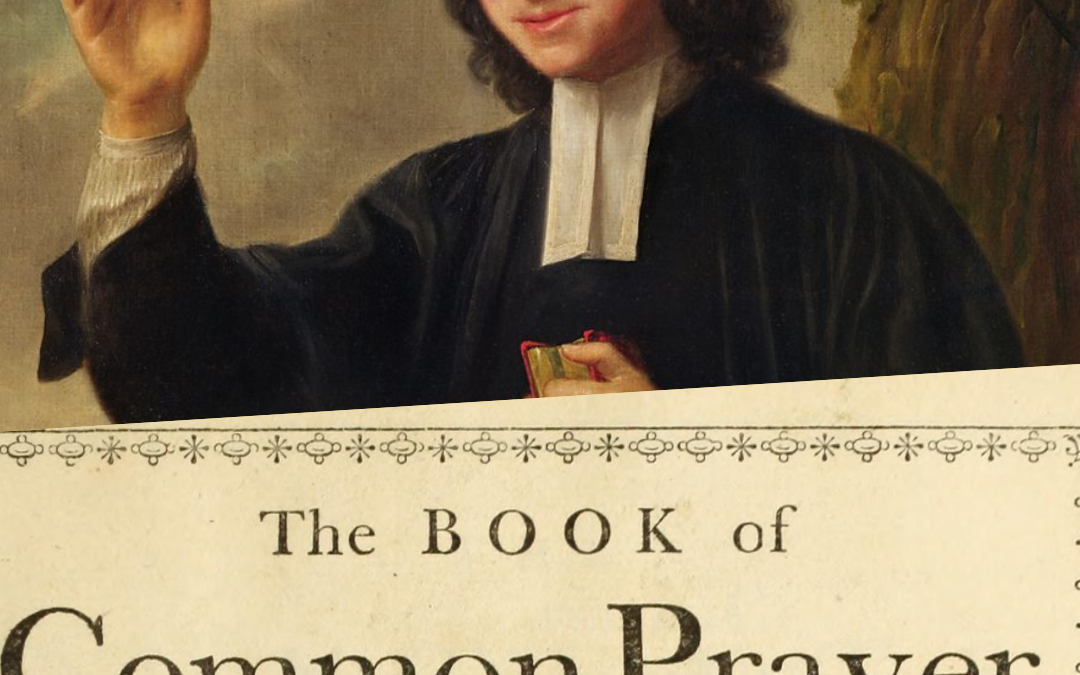
John Wesley is seen as the grandfather, or great-grandfather of much of the evangelical, and charismatic movements. And right so! During the Great Awakening in England, and the advent of the Methodist movement, Wesley was the spearhead, along with his brother Charles, George Whitfield, and others in seeing salvation and holiness come to the lives of many thousands. Many are familiar with his Aldersgate experience where his heart was strangely warmed. Somewhat less well known, but likely even more important was Wesley’s experience at Fetter Lane.
What many don’t know is that following his experience at Aldersgate, John was still depressed. While he certainly felt assurance and peace of his salvation in Christ, something wasn’t right still. This is where at Fetter Lane that John, Charles and about sixty others experienced a powerful move of the Holy Spirit, and it was just a short time after this experience that Wesley’s preaching really kicked off. It was once Wesley experienced a powerful move of the Holy Spirit that everything clicked into place for him. Not too dissimilar to the Apostle’s following the ascension of Christ. Once the Holy Spirit fell on Pentecost, everything made sense, and the move of God was empowered to go out into the world and change lives.
I also want to take note of something peculiar to us that happened at Fetter Lane. Not only did Wesley and those gathered experience what we can only describe as a charismatic experience, but following that experience Weslry writes,
“As soon as we recovered a little from that awe and amazement at the presence of his majesty, we broke out with one voice, “We praise thee, O God; we acknowledge thee to be the Lord.””
What is this prayer that was uttered by all? It’s called the Te Deum Laudamus, a prayer found in the Book of Common Prayer.
For those who don’t know, the Book of Common Prayer (BCP) is the primary book of worship for the Anglican Church. The first authorized and published version was in 1662, and I would say is likely one of the biggest influences on Christian worship that came out of the reformation. The primary author was Thomas Cranmer, the Archbishop of Canterbury, and leader of the Church of England as it came out of the Roman Catholic Church. Cranmer;s focus and goal was to bring the worship services of the Church to the people in their common language so they could actively particiapte.
It is this book that formed and shaped the spirituality and Christian walk of John Wesley, and any Anglican Christian. In fact, in most of John’s sermons, when he is quoting the book of Psalms, he doesn’t directly quote the King James Bible, but utilizes the translation of the psalter found in the BCP.
So what does the BCP have to do with Fetter Lane, John Wesley, or spirit-aliveness in general?
While it is very easy to focus on the fruit and the excitement of the Methodist revival, and the obvious move of the Holy Spirit through Wesley, we more often than not overlook the foundation that built the spiritual disciplines and language of Wesley’s faith in Christ. Every singe part of John’s Christian practice was built around two documents. The Bible, and the Book of Common Prayer. For prayer times, worship services, baptisms, Communion, weddings, funerals, ordinations, prayers, everything else under the sun you could think of that goes on in our lives has something for it in the BCP. And for John he would have utilized the BCP for it all. Other than the Bible, the BCP was the most formational book that John would have used.But sadly, it is so easy for us to miss it because it is outside of our sght or experience.
My argument and proposal is that if we are wishing to see and experience the same levels of spirit-aliveness in our day and age, it will not simply come from looking at just the fruit of the Methodist movement. We must look to the roots. And aside from God’s Word, the other inescapable part of that foundation is the BCP.
So what should we do with this?
The reality is that for most, it doesn’t make sense to fully implement something like the BCP in our worship contexts. But what we should be looking at is how do we develop regular spiritual disciplines that are formed around the common worship of the Christian faith since the earliest days of the Church.
What we often see is that anything that seems lile liturgy, or formulated worship is quickly labelled as “dead religion”, and not something that the Holy Spirit can work through. My challenge to those reading this is to, rather than seeing liturgy as a straight jacket, see it as a foundation for the Holy Spirit to work through.
Let’s be honest, extemperanous prayer can sometimes be a mess. Or, we don’t always know what to pray, or don’t feel like praying. What liturgy, and other forms of similar worship/prayers (as found in the BCP) provide us the tools for faithful worship at all times. Just because it is written down, doesn’t means it’s “any less effective”.
The automatic and unison response at Fetter Lane to the move of the Holy Spirit was to pray something directly from the BCP, something that was foundational and formational in the spiritual lives of those present.
In an age where the most popular worship song changes every other week, and the next spiritual fad is coming and going, what many of us need in the Church is the beauty and stability that comes from the classic worship of the Church.
For those of us in the Free Methodist Church. We are seeking for spirit-aliveness to grow in our personal lives and congregations. Let’s take page 1 out of Wesley’s play book, and see how the methodical and beautiful spiritual formation that coes from the BCP can actively transform and change what we see as decline into healthy growth.
This article is an introduction of a series that I am going to be doing specifically on the Book of Common Prayer, and it’s relation to Free Methodism. I’ll be doing a deeper dive intro into the BCP, and then also have a series of articles relating how the BCP can be a transformational part of each element of the Free Methodist Way.

by Joel V Webb | Jan 23, 2025 | Uncategorized
In recent days (as there has been since 2015). there has been a lot of back and forth between Christians on either side of the immigration debate. Those who I believe are true brothers & sisters in Christ hold to positions that in American politics can be found on either the right or the left, and in that I do not questions their desire to reflect Christ in the midst of a divisive issue during divided times.
The part that I have been struggling with, as I often seem to do is walking the via media, or the middle way that John Wesley (and his Anglican heritage) was famous for.I find myself stuck between two camps warring with each other, both making excellent points, while also seriously glazing over other realities. It is in this light that I want to try and address briefly an issue I see with both sides, and hopefully present an alternative.
First to the left.
As just happened during the Inauguration Prayer Service held at the National Cathedral in D.C., a generally unobjectionable homily was presented, calling for peace and unity in our nation. And yet, at the end it was punctuated with obviously left-leaning political positions on border policy, and sexuality questions. This was then of course followed by the shield rattling from both sides, getting up in arms defending or attacking all that went on, with the expected utilization of several verses, presumably giving Christian a blanket mandate to accept a certain type of border politics, often resembling open-border policies.
“When an alien resides with you in your land, you shall not oppress the alien. The alien who resides with you shall be to you as the native-born among you; you shall love the alien as yourself, for you were aliens in the land of Egypt.” – Leviticus 19:33-34
“Thus says the Lord: Go down to the house of the king of Judah, and speak there this word, and say: Hear the word of the Lord, O king of Judah sitting on the throne of David – you, and your servants, and your people who enter these gates. Thus says the Lord: Act with justice and righteousness and deliver from the hand of the oppressor anyone who has been robbed. And do no wrong or violence to the alien, the orphan, and the widow, or shed innocent blood in this place.” – Jeremiah 22:1-3
These are two of the primary examples of the verses that I have seen be apart of this discussion. The problem that I have is not with the general message that I believe all Christians should accept. There are many in need, and we should be generous, kind and loving to those as it is an opportunity to share the hope of the Gospel. Yet, it is often taken a step further to presume that the only way to interpret these verses is with a basically open-border policy. When I have seen these verses used, it is completely devoid of any actual context, or careful interpretation as to the application today as the times Scripture was given was vastly different than our own. This is not a situation where there is a one-to-one application. In an excellent article titled, The Use and Abuse of the Bible in the Immigration Debate, James Hoffmeier carefully presents three key considerations when looking at texts in the Old Testament in regards to their modern application. These questions are, “1) Was there such a thing as territorial sovereignty in the second millennium B.C. when these laws originated; 2) Within that socio-legal setting, what was a “stranger” or “sojourner;” and 3) How does one obtain this status?”
As he fleshes out these questions, it becomes clear that for Christians living in the 21st Century, there is not a blanket transfer of these verses in applying them to modern border policy. I believe that Christians who attempt to apply these texts and others in this way are sadly being either misinformed, or dishonest in not seriously considering the complexities of the application at the time of writing, and then do the same for out modern day immigration discussion.
Now to the right.
Being someone who is generally more conservative in his politics, I have been appalled the last decade at some of the discussion surrounding immigration. I have witnessed or heard language that is obviously racist or xenophobic (I don’t use those terms lightly). While diligence should be used in our immigration policy, that can also be used as a pretense to be closed off, and not open to the real dire situations of people around the world.
The mass migration of many people is in my mind one of the greatest ministry opportunities afforded to the American Church, likely since our nations founding. With people coming from many nations, even hostile to us, could be the opportunity Christ is affording for them to hear the Gospel. I remember hearing a story several years ago of someone who immigrated from the Middle East, and when they came over they brought many gifts that they could give out when they would get together with people. But some time after coming to the US, they were dejected because not one person had shown hospitality, and invited them for a meal where they would have bestowed one of their gifts.
Much of the response about immigration on the right side of the aisle is built on fear, and a holding to the idea that American is the solution, and we have to keep her alive. Don’t get me wrong, I love this nation, and I believe God has used America, and will continue to (as imperfectly as we follow). But, like St. Augustine realized with Rome, God’s purposes do not start or end with an earthly nation. Instead, all subjects of King Jesus are really foreigners in lands that are not our own.
The via media
Is there a balance that can be struck between these two seemingly impossible sides? I believe that there is. The Gospel provides answers that frankly makes both sides shiver a bit because it throws into questions motives and answers as not complete, without balance.
Being merciful and loving to those in need is not mutually exclusive to having legitimate border policy. I hear people talking on an on about how we need to accept people in to show we love them, while much of the crossing into the US is conducted by human traffickers who take advantage of those they are leading in many ways. I believe that if we truly cared for those seeking to come into this country, it would be in a way that protects them from drug-mules and human-traffickers.
Also yet, we in the American Church need our hearts checked. So much fear has been built up around this issue. Do we not believe that God is in control? Better yet, do we not see what is going on (whether we agree with it politically or not), as an opportunity for us to proclaim the Gospel, and love as the hands and feet of Jesus in a way that we couldn’t do before? For many of us, hopping on a plane to minister in another country isn’t feasible. Well…the nations are at our front door.
This is a challenging discussion, and these certainly are not all my thoughts on this discussion. But I wanted to present a window into a perspective that I feel is not getting to see the light of day, one that is not lop-sided to either the right or the left. An ideal that hold the difficult realities and complexities of life in tension with each other.
by Joel V Webb | Jan 16, 2025 | Uncategorized
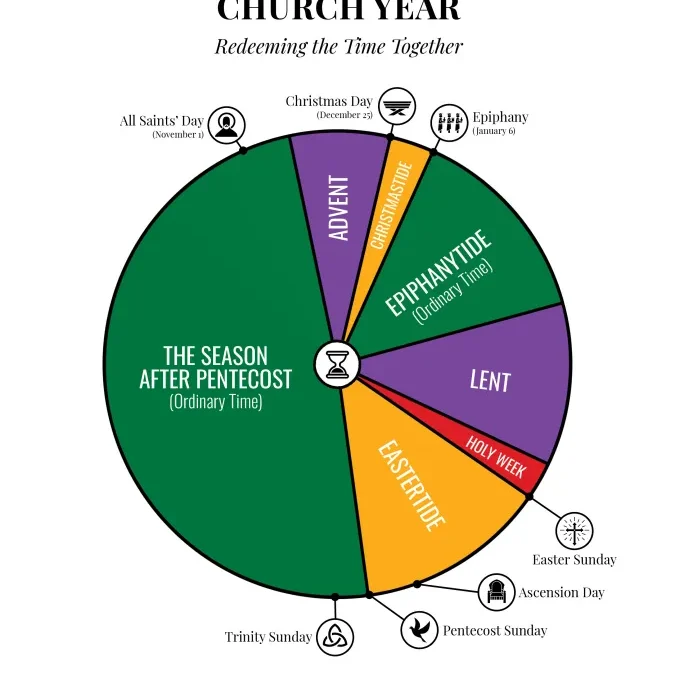
Growing up I never really knew there was such thing as the liturgical calendar. Being from a low-liturgy, low-tradition background, I could recognize different churches having colorful “flair” in their sanctuaries, but had no idea they changed, or even what they stood for. Over the last several years I have been on a journey, that has been for me full of joy and wonder at the riches of the variety of traditions that the Church offers. One of these that I have begun to look at is the church calendar.
We are all use to the normal flow of holidays. Whenever Halloween is over, the stores change over their stock in preparation for Thanksgiving and Christmas, and then after the New Year, promptly switch to Valentine’s Day. So on and so forth we see the changing signs of the seasons and upcoming holidays. In a similar, but much more profound way, the Church follows a calendar with changing colors, liturgies and practices that take the believer not just through 365 days, but has them participate in the story of the Gospel.
From Advent where we expectantly wait for the birth of Christ, to Lent where we solemnly prepare for Holy Week, and Good Friday, while also knowing the joy and victory of Easter is on the precipice.
Something that I feel much of contemporary evangelicalism is missing out on is the annual participation in the Gospel story. Being constantly reminded of Christ’s work through the story of Scripture is a powerful way that we are also reminded of the work He is doing in our lives, and thus by living as apart of that story we can be shown how to live in light of that in our secular age.
As I, and many others have said before, humans are creatures of story. You can spit off a bunch of facts that are true and correct, but if they don’t connect with someone, you might as well be talking to a brick wall. But engage someone in a story, where they become invested in what takes place, and they understand the stakes, the resolution…that can change everything. This is where the liturgical calendar can come in. More than just a thing that tells us what color decorations to hang in a sanctuary, it is participation in the story of the Gospel. As we go through the ebbs and flows of the year, every part of our being is touched. We feel the highs of Christmas, Easter and Pentecost, and are also brought low during Lent & Good Friday. The entirety of human emotion is encapsulated through the Gospel story, and it speaks to the truth of how God worked, and is now working.
For more in-depth information on the Liturgical Calendar, and how to use it, check out Holy Joys, and their fantastic resources.

by Joel V Webb | Aug 28, 2024 | Uncategorized
I recently saw a post from a person in the Christian camp, who is
also a pastor pointing to the reasons he will be voting for a
particular presidential candidate this November. He somewhat listed
off some of the fruit of the Spirit found in the book of Galatians,
claiming his candidate of choice represents joy, and other
attributes, while the other represented meanness and selfishness.
There are two things I want to address with this.
1. Politicians are
trying to sell to you. It doesn’t matter if it is Kamala Harris,
Donald Trump or any other politicians from the federal to the local
level, they want to get elected. To suggest that any political
candidate truly represents the fruit of the Spirit, and that is
reason enough to vote for them is frankly vapid. A politician wants
to get elected, that’s what they are out there campaigning for
votes. It doesn’t matter if you are Republican or Democrat, your
chosen leader does not embody the fruit of the Spirit. And whether
they “bring joy” or not, I just about guarantee it is
manufactured. If you are bought in, it is from gullibility, or more
nefarious desires to convince people to vote against their conscience
because the other person is mean.
2. To become a bit
more pointed and direct. No one is able to claim they are a
politician for the joy when there is an outright unapologetic support
for no limit, on demand intentional killing of children. In this
conversation I don’t care about economic or foreign policy
discussions (as important as they may be). While one side is slowly
moving away from the strong pro-life position it has held for a long
time, the other side has no legs to stand on. How can there be joy
when any perception of that emotion is built off of the backs of
destroyed humans for the sake of personal convenience?
This election season
remain light & salty. Don’t become unnecessarily persuaded by
the arguments of either side. Loving God and loving people in truth
is primary, so go and do that.
by Joel V Webb | Jul 29, 2024 | Uncategorized
This last weekend I went to Washington D.C with my wife to lead a bus for an organization called Passages Israel which provides trips to Israel for Chrisitan college students. these trips highlight the Jewish roots of the Christian faith, explore the history of Chrisitan-Jewish relations and provides an honest and in-depth look at the current Israeli-Palestinian conflict. The terrorist attack on Oct. 7th led to Passages launching a D.C trip to fill in the gap until tours in the country were open.
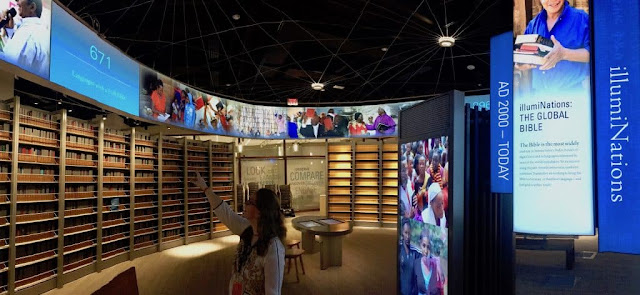
Part of the trip is visiting the Museum of the Bible (MOTB).If you have not visited this amazing museum yet, DO IT! It is worth the trip to DC alone.
In the entire museum one of my favorite rooms is the translation room. In it they have almost every language the Bible is translated on one shelf, with the rest of the room representing languages that have partial translations, portions translated, in process, or no translation in process at all (pictured above). The thing that struck me this time was the realization that with few exceptions, most languages in the world only have a single translation. That’s it! 1 translation of the Bible. While in English there is an insane plethora of translations spanning the spectrum of word-for-word and thought-for-thought. The thing in particular that struck me is the frank ridiculousness of the “translation wars” that is a constant back and forth within Western Christianity.
We have everything from the KJV as the only perfect translation for the English language, to some in the NAR hyper-Pentecostal camp producing the heretical translation known as the Passion Translation (TPT). With the exception of the latter mentioned Bible version (that is not a translation by any serious Biblical scholar) the best translation is the one you will read. I grew up reading the KJV, and now find myself often using the NLT and the NIV for personal devotion, study an preaching.
But in the big picture we have to realize that the majority of modern translations are excellent. And in comparison, those who speak English are amazingly blessed! In many nations and languages there is only one translation of the Scripture into their heart language, and in some cases that’s if they even can get a copy because the Bible is illegal as our brothers and sisters in Christ face persecution.
All of this to say, whichever English translation you utilize, consider it a blessing that you have it. Consider the ability you have to choose a specific translation a humble honor and that you are the part of a minuscule minority across the world and history that has the ability to bicker about what translation you get to use.
Ultimately the Bible is the means by which we come to know Christ. The Bible in and of itself is not God. Yes, it is His perfect revelation to mankind concerning who He is. It shows us, a broken humanity the way to the One who gives us new life and salvation in the perfect and loving God who created all things. Christ is the Word (the logos), but the words on the page before us is not God, and we need to be careful not to confuse to two.
Find a Bible that you will read. Read it often, read it deeply, read it for all its worth, study its challenging words and ask the Holy Spirit who lives in every believer to make you more like Jesus which it all points to. In this be humble, and pray for those who do the important work of translating the word of life for people who will ever only likely have one Bible to ever choose from…if they can get a copy.

by Joel V Webb | Jul 8, 2024 | Uncategorized
An image that is used in Scripture, and by extension preaching is the idea of being pruned. When a plant grows, sometimes the way that it is growing does not contribute, but actually takes away from the fruit production of the plant. Jesus talked a lot about the fruit we produce, and it’s importance for the Kingdom. We know for all of us that there may be things (even if they are good) that need to be pruned and removed so that we can actually be the most fruitful.
This principle is pretty accepted across the board as part of Christian growth, and can be applied not just to individuals, but to organizations like churches and denominations as well. The message of the Gospel never changes. And sometimes the structure, organization or method that we proclaim that message needs to be modified or adapted to be more effective. Cut off the excess to bear more fruit. This is normal and expected. As the world around us changes so do the methods and way things look.
But this is not always the case. We often ask the question (personally or corporately), “there’s not a lot of fruit, so there needs to be pruning”, or similarly ask, “things seem really small and cut back, maybe were preparing for fruit!” And these certainly could be legitimate. We could be in a season where things have been hacked back to prepare for new growth that will bear fruit. But sometimes things being small is not because of pruning…it can be because of rot.
Something my pastor has said before, “we often say if there is opposition that it must be the enemy. But we never ask the question, what if it is God?” WHAT? How could God be the one opposing us if we are His people? Very simply, He will if we are not bearing the message of the Gospel and representing His Kingdom.
If we (individually or corporately) acting as ambassadors of Christ’s Kingdom do so in a way that actually harms, abuses and hurts people, do we think that the Lord would support that? Yes, He is long suffering and great in His mercy. AND THANK HIM FOR THAT!! Because we all need His mercy. But even Israel was eventually judged for their injustice and evil committed.
There are sadly so many examples of churches that while bearing Christ’s name have used it to domineer, control and tell people what to do. These places are hiding holes for spiritual, emotional and sexual abuse. And while many of these organizations had their hayday (IBLP etc…) the abuse and fruit become evident very quickly. When people start leaving when they realize what is going on the response often inside these organizations is just like the false prophets of the Old Testament who opposed any message that was not positive.
I recently heard such a message from an organization I am very familiar with that has demonstrated many of these qualities. Their message will often be “God is pruning us so we can be ready to bear fruit!!!” The expectation of some kind of revival around the corner that will fill their seats because they are small.
Is this a possibility? It could be. But we also need to ask, could it be for the other reason that instead of being pruned we are actually rotting? Have we, or I for so long refused to look at the truth of what is going on around me and am sadly self-deceived into thinking whats actually happening is God preparing to move through us, rather than against us?
I ultimately believe that God is for us, and He loves us. Scripture makes that abundantly clear. And, He also opposes those who oppresses and hurt the helpless, and misrepresent His name. So it is a possibility that it could be God allowing the fruit of out tree to bloom to show other to steer clear. As Jesus said, “you shall know them by their fruit” (Matt. 7:15-20).
What can we or should we do? We should all pray and ask the Lord to open our eyes through His Holy Spirit to the blind spots in our lives. If pride or deception has blinded me it is impossible to see on my own. I need the help of the Holy Spirit, through my brothers and sisters in Christ to lovingly tell me where I have erred and where there is rot, so I can subject it to the loving work of Jesus to change and transform.
This can happen in a corporate setting as well. It is and will be painful if it ever happens at all, but it is worth the pain because of the gain in Jesus.
I humbly pray this for myself, and for all of us to know the one who took our place.
DV